
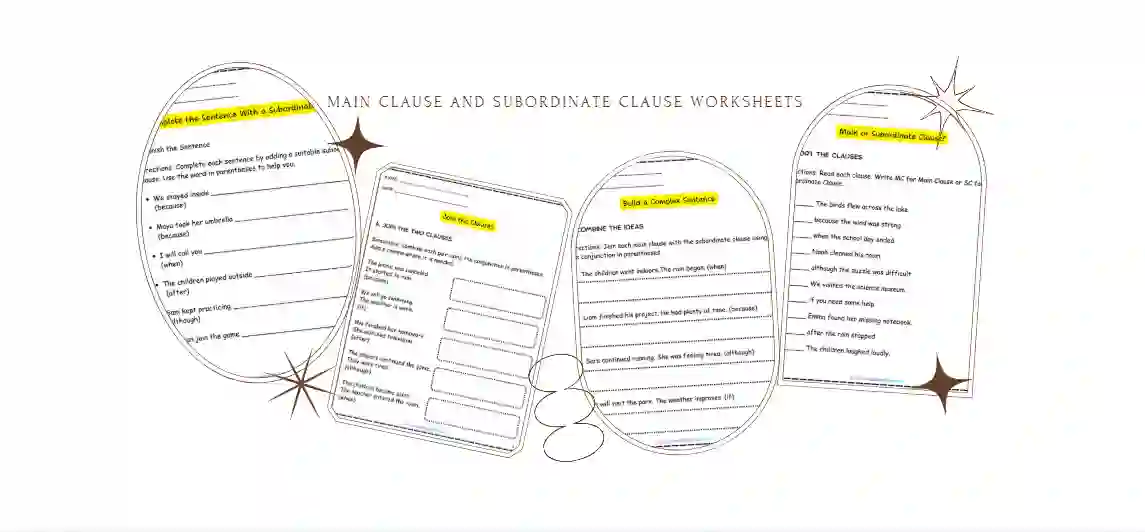
Understanding how clauses work helps students build stronger and more detailed sentences. A main clause expresses a complete thought and can stand on its own, while a subordinate clause adds extra information but depends on a main clause to complete the meaning. Learning to recognize how these two types of clauses work together is an important part of Grade 5 grammar.
These Main Clause and Subordinate Clause Worksheets for Grade 5 provide focused practice in identifying and using different types of clauses. Students will identify main and subordinate clauses, match clauses that belong together, complete sentences, and combine clauses to create meaningful sentences.
Whether you are a teacher planning a grammar lesson, a parent supporting learning at home, or a student looking for extra practice, these Grade 5 grammar worksheets offer a simple way to strengthen sentence-building skills. The activities are designed to make clause worksheets useful, engaging, and easy to use in the classroom, homeschool setting, or for independent practice.
Why Practice Main and Subordinate Clauses in Grade 5?
- Grammar development
- Sentence construction
- Reading comprehension
- Writing fluency
- Complex sentence formation
- Overall language skills
What Is a Main Clause?
A main clause is a group of words that contains a subject and a verb and expresses a complete thought. It can stand on its own as a sentence, so it is also called an independent clause. A main clause can also be joined with a subordinate clause to create a longer, more detailed sentence.
Example: Mia finished her homework.
This is a main clause because it gives us a complete idea – Mia is the person doing the action, and finished tells us what she did. The sentence makes sense by itself.
What Is a Subordinate Clause?
A subordinate clause is a group of words with a subject and a verb that does not express a complete thought by itself. It needs a main clause to make the sentence complete. Subordinate clauses often begin with words such as because, although, when, while, if, since, before, or after.
Example: because she had a test tomorrow
This clause leaves us waiting for more information. When it is joined to a main clause, the meaning becomes complete:
Mia finished her homework because she had a test tomorrow.
Here, Mia finished her homework is the main clause, while because she had a test tomorrow is the subordinate clause.
Main Clause vs. Subordinate Clause
| Main Clause | Subordinate Clause |
|---|---|
| Expresses a complete thought | Does not usually express a complete thought |
| Can stand alone | Needs a main clause |
| Also called an independent clause | Also called a dependent clause |
| Example: We stayed inside. | Example: because it was raining. |
How to Identify Main and Subordinate Clauses
Finding clauses becomes easier when you follow a few simple steps:
- Find the subject and verb in the group of words.
- Ask if it expresses a complete thought.
- Look for a subordinating conjunction such as because, when, although, or if.
- Check if it can stand alone. If it can, it is usually a main clause; if it cannot, it is a subordinate clause.
- Separate the clauses and identify their roles in the sentence.
Worked Examples
1. We stayed inside because it was raining.
- Main clause: We stayed inside.
- Subordinate clause: because it was raining.
2. When the bell rang, the students left.
- Subordinate clause: When the bell rang
- Main clause: the students left.
3. Liam smiled although he was tired.
- Main clause: Liam smiled.
- Subordinate clause: although he was tired.
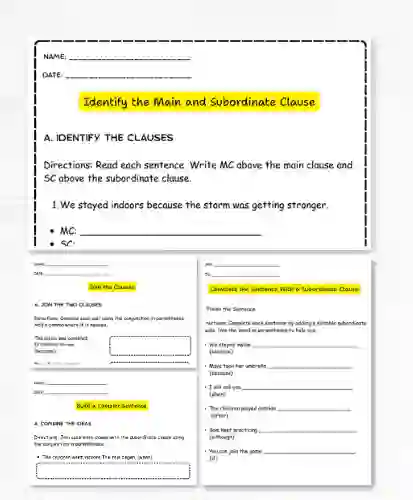
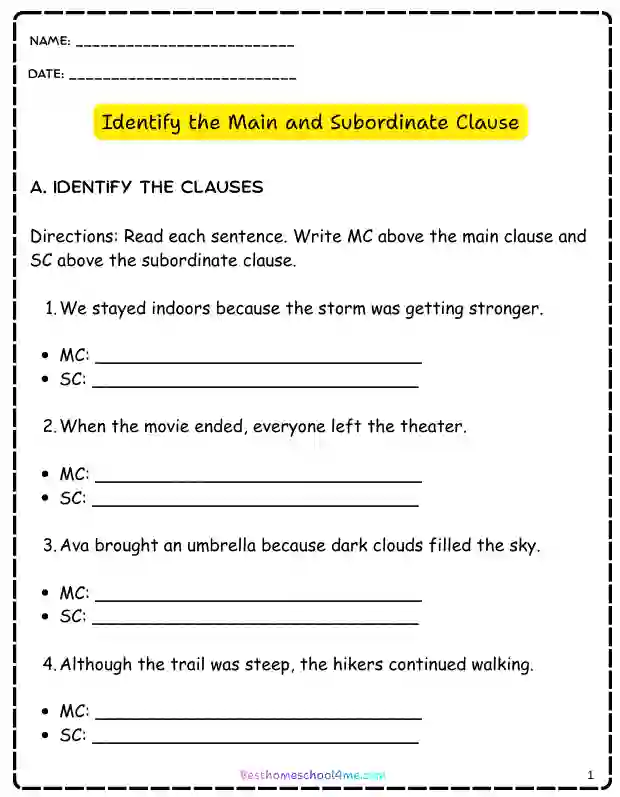
Identify the Main and Subordinate Clause Woksheet
This worksheet helps Grade 5 students recognize the difference between a main clause and a subordinate clause. Students will read sentences, separate the clauses, and label each part correctly while strengthening their understanding of sentence structure.
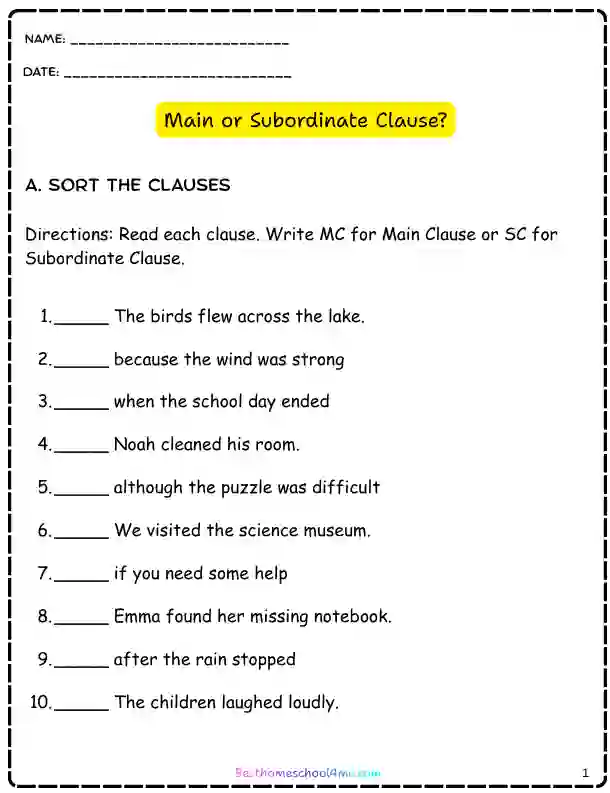
Main or Subordinate Clause Worksheet?
This worksheet gives students focused practice in deciding whether a group of words is a main clause or a subordinate clause. Students will look for complete thoughts, recognize dependent clauses, and build confidence with clause identification.
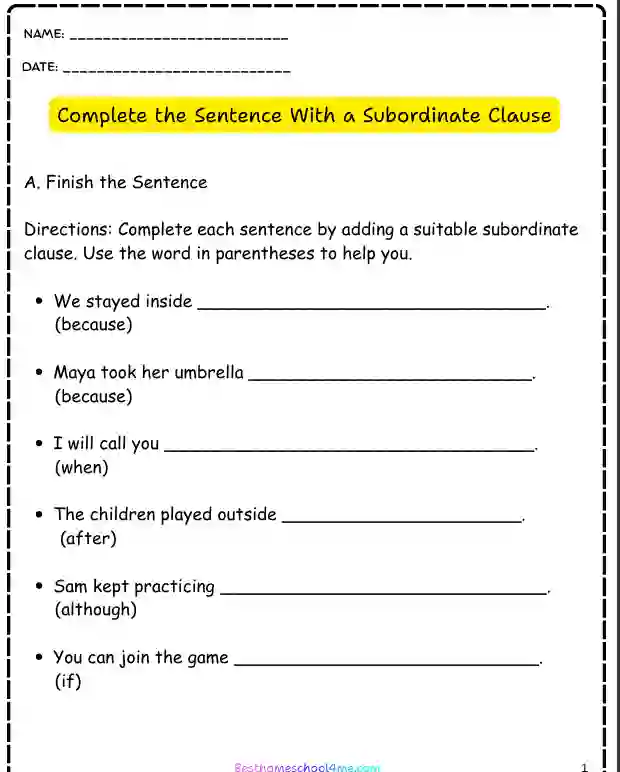
Complete the Sentence With a Subordinate Clause
This Grade 5 worksheet helps students learn how to add a subordinate clause to a main clause and create a complete, meaningful sentence. Students will use subordinating conjunctions and their own ideas to expand simple sentences.
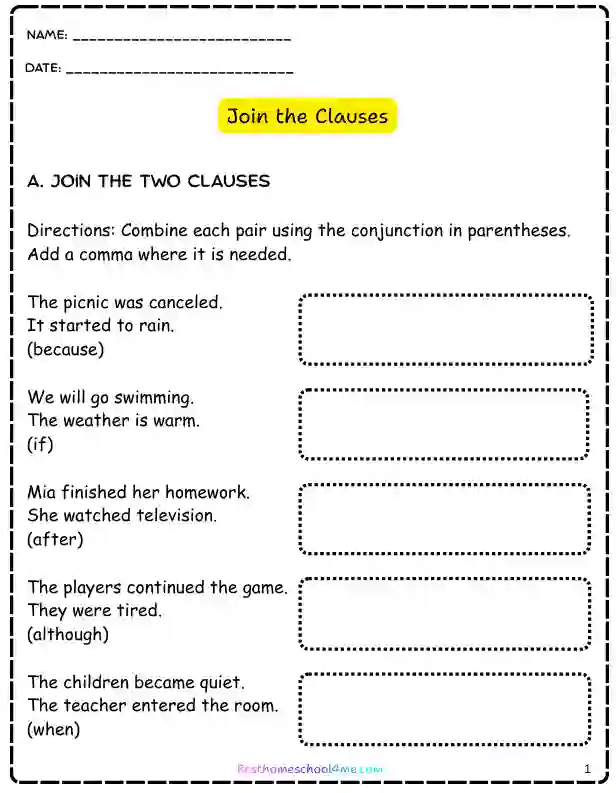
Join the Clauses
This Grade 5 worksheet helps students practice joining main and subordinate clauses to create complete sentences. Students will choose suitable subordinating conjunctions, combine ideas, and improve simple sentences by adding meaningful details.
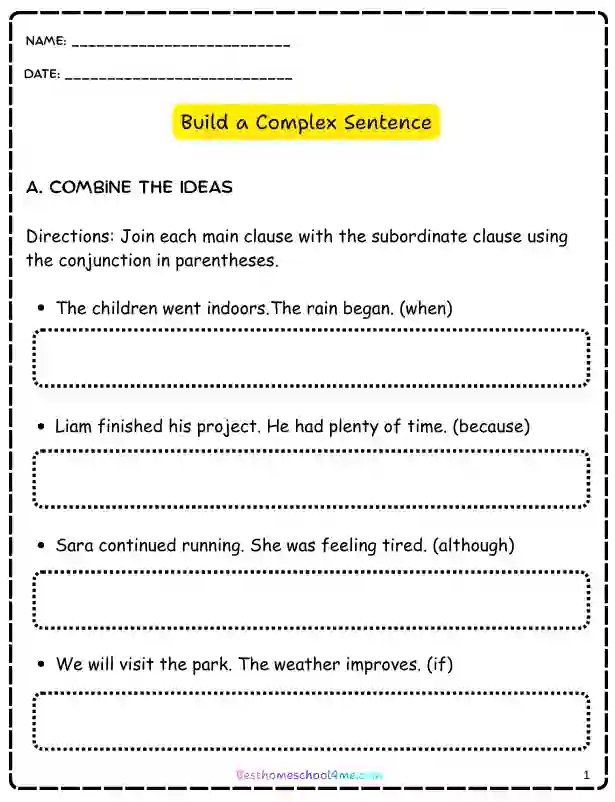
Build a Complex Sentence
This Build a Complex Sentence worksheet helps students combine a main clause and a subordinate clause to create clear, meaningful complex sentences. Students will use subordinating conjunctions, expand simple ideas, and write their own sentences.
Common Subordinating Conjunctions for Grade 5
Subordinating conjunctions are words that introduce a subordinate clause and connect it to a main clause. They help show relationships such as reason, time, condition, or contrast.
| Subordinating Conjunction | Example |
|---|---|
| because | We stayed home because it was raining. |
| although | Although she was tired, she finished her work. |
| when | When the bell rang, we packed our bags. |
| while | I read while my brother played. |
| if | If you practice, you will improve. |
| unless | We cannot start unless everyone is ready. |
| since | Since it was late, we went home. |
| before | Wash your hands before you eat. |
| after | We played outside after the rain stopped. |
| until | Wait here until I return. |
| whenever | Whenever she visits, we bake cookies. |
Tips for Teaching Main and Subordinate Clauses to Grade 5 Students
- Start with complete sentences.
- Teach independent vs. dependent clauses gradually.
- Use color coding.
- Have students physically separate clauses.
- Practice with conjunctions.
- Move from identification to sentence writing.
Common Mistakes Students Make With Clauses
- Treating a subordinate clause as a complete sentence.
- Confusing a phrase with a clause.
- Forgetting the main clause.
- Choosing an inappropriate conjunction.
- Creating sentence fragments.
- Misusing commas when combining clauses.
Explore More Worksheets-
- Cost Price and Selling Price Worksheets
- Analogy Worksheets
- Snow Leopard Worksheets: Facts, Habitats & Adaptations
- Allusion Worksheets With Definitions, Examples & Practice
- Double Entendre Worksheets With Definitions, Examples & Practice
- Peppa Pig Printable Worksheets
- Cursive Writing Paragraph Worksheets
- American football worksheet for kids
- Human Impact on the Environment Reading Comprehension Worksheets
- Canadian Government Worksheets
- Bluey Coloring Pages
Frequently Asked Questions About Main Clause and Subordinate Clause Worksheets
What is a main clause and a subordinate clause for Grade 5?
A main clause expresses a complete thought and can stand on its own, while a subordinate clause depends on a main clause to complete its meaning. Grade 5 students can practice both with main and subordinate clause worksheets and sentence activities.
What are the best main clause and subordinate clause worksheets for Grade 5 students?
Effective main clause and subordinate clause worksheets for Grade 5 should include activities such as identifying clauses, completing sentences, joining clauses, and building complex sentences. These exercises help students strengthen grammar and sentence-writing skills.
How can students identify a subordinate clause in a sentence?
Students can look for a subordinating conjunction such as because, although, when, if, or after. They should then check whether the clause expresses a complete thought on its own. Subordinate clause worksheets provide useful practice for developing this skill.