An allusion is a brief reference to a familiar person, place, event, character, story, historical moment, or cultural idea. Writers use allusions to communicate an idea without explaining the entire reference. When readers recognize the connection, a simple phrase can carry much more meaning.
For students, learning how to recognize an allusion is an important reading and language arts skill. A sentence may seem ordinary at first, but a familiar reference hidden inside it can reveal a character’s personality, strengthen a theme, add humor, or help readers understand an author’s message.
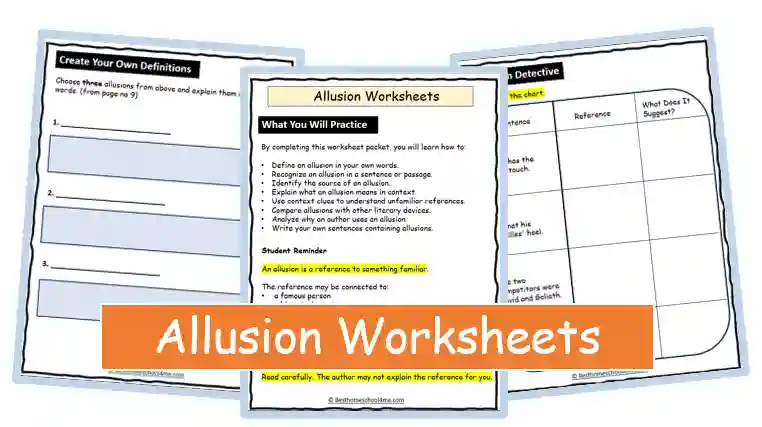
These printable allusion worksheets give students an opportunity to learn what an allusion means, identify allusions in sentences and passages, explain their meanings, and practice creating their own examples. The activities can be useful for classroom instruction, independent practice, homeschool lessons, literacy centers, and English language arts review. You can download the worksheet from the “Download” section below.
What Is an Allusion?
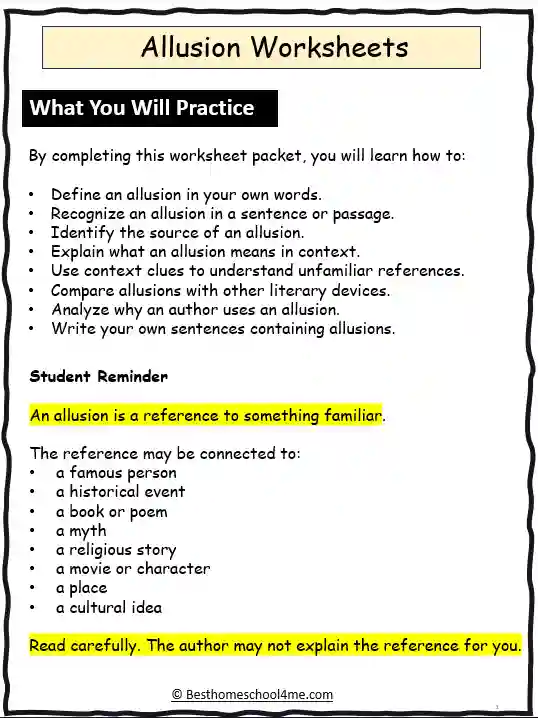
An allusion is an indirect reference to something the writer expects the reader to recognize. The reference may point to a famous person, book, myth, historical event, movie, place, song, character, or cultural idea.
The important part is that the writer does not fully explain the original reference.
For example: “After losing the championship, Marcus felt like his own Achilles’ heel had finally caught up with him.”
The phrase “Achilles’ heel” refers to Achilles from Greek mythology. In the myth, Achilles has one vulnerable spot—his heel. In everyday writing, the expression can refer to a person’s particular weakness.
The writer does not need to retell the story of Achilles. Readers who know the reference understand the additional meaning.
A dictionary definition describes an allusion as something said or written that is intended to make the reader think of a particular person or thing.
How Does an Allusion Work?
An allusion works by making a connection between the words on the page and something the reader already knows.
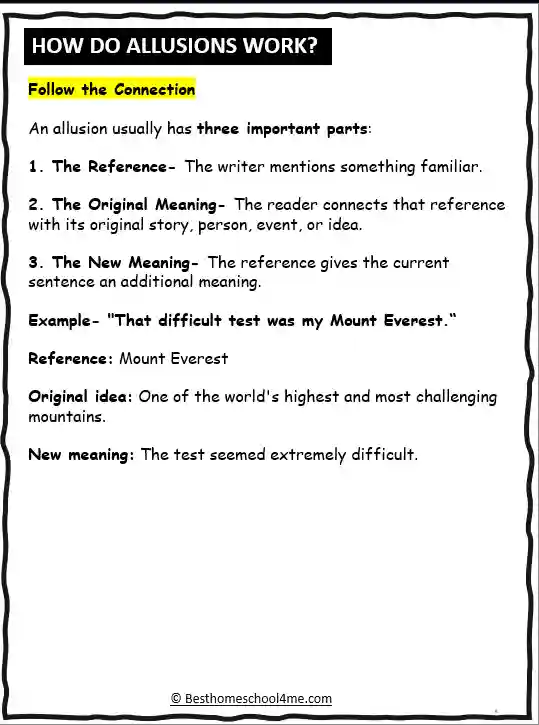
Consider this sentence: “Walking into the final exam, Jake felt as if he were facing Mount Everest.”
The writer is not saying that Jake is actually climbing Mount Everest. The reference suggests that the exam feels extremely difficult or challenging.
The allusion gives the reader a bigger idea without requiring a long explanation.
This is one reason writers use allusions so often. A short reference can suggest an entire story, personality, historical event, or cultural idea.
Why Do Writers Use Allusions?
Authors use allusions for several reasons.
1. To Add Meaning
A familiar reference can give a sentence an additional layer of meaning.
2. To Make Writing More Interesting
Allusions can make descriptions and comparisons more memorable.
3. To Connect With Readers
A familiar reference can create an immediate connection between the writer and the audience.
4. To Develop a Character
A character’s use of a particular allusion can reveal what the character knows, values, fears, or believes.
5. To Strengthen a Theme
An allusion can connect a story’s theme to a well-known historical, literary, or mythological idea.
6. To Say More With Fewer Words
Instead of explaining an entire story, an author can use a short reference and allow the reader to make the connection.
Allusion Examples for Students
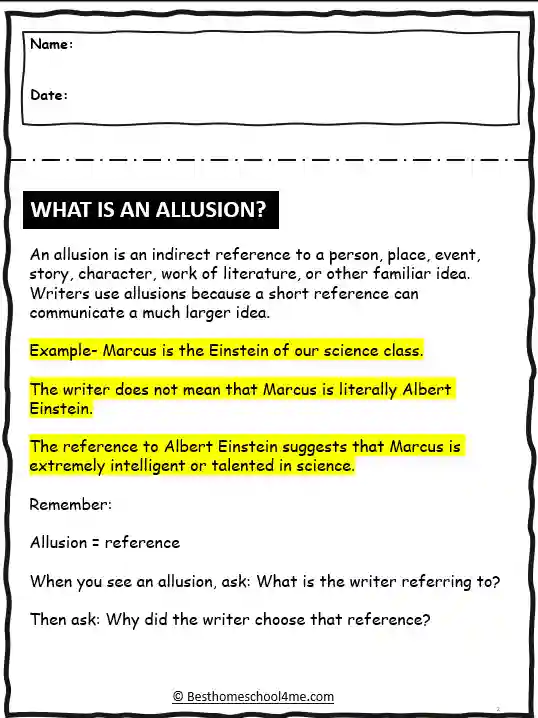
The best way to understand an allusion is to see it in context.
Example 1: Achilles’ Heel
Sentence: “Math has always been Jordan’s Achilles’ heel.”
Reference: Achilles from Greek mythology.
Meaning: Math is Jordan’s particular weakness.
Example 2: Pandora’s Box
Sentence: “Opening that old file could be like opening Pandora’s box.”
Reference: Pandora’s box from Greek mythology.
Meaning: Opening the file could create many unexpected problems.
Example 3: Einstein
Sentence: “Everyone asked Maya for help because she was the Einstein of the science group.”
Reference: Albert Einstein.
Meaning: Maya is being described as extremely intelligent.
Example 4: Cinderella
Sentence: “After years of being overlooked, the small team became the Cinderella story of the tournament.”
Reference: Cinderella and the familiar idea of an unexpected rise from an overlooked position.
Meaning: The team succeeded despite not being expected to win.
Example 5: David and Goliath
Sentence: “The small bookstore’s battle against the giant corporation felt like David versus Goliath.”
Reference: David and Goliath from the Bible.
Meaning: A much smaller or weaker side is competing against a powerful opponent.
Example 6: Trojan Horse
Sentence: “The harmless-looking email turned out to be a Trojan horse.”
Reference: The Trojan Horse from Greek mythology.
Meaning: Something that appears harmless is actually being used to hide a threat or harmful purpose.
Example 7: Romeo and Juliet
Sentence: “The two families treated their relationship like a modern-day Romeo and Juliet story.”
Reference: Shakespeare’s Romeo and Juliet.
Meaning: The relationship is affected by conflict between the two families.
Example 8: Kryptonite
Sentence: “Public speaking is his kryptonite.”
Reference: Kryptonite from Superman stories.
Meaning: Public speaking is his particular weakness.
Example 9: Midas Touch
Sentence: “Whenever Elena starts a new business, it seems as if she has the Midas touch.”
Reference: King Midas from Greek mythology.
Meaning: She seems unusually successful at making things profitable or valuable.
Example 10: Big Brother
Sentence: “The constant cameras made the workers feel as though Big Brother was watching.”
Reference: Big Brother from George Orwell’s 1984.
Meaning: The workers feel that they are being watched or monitored.
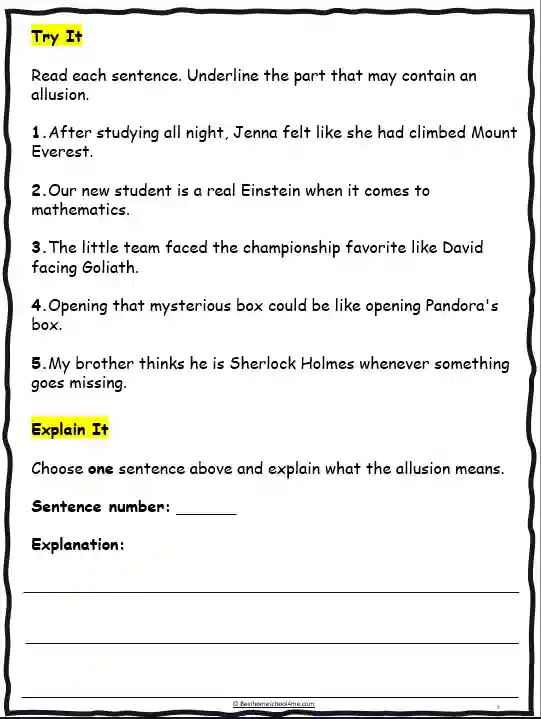
Types of Allusions
Allusions can come from many different sources. Students should learn to look beyond mythology and classic literature because writers make references to history, popular culture, religion, science, sports, and other familiar subjects as well.
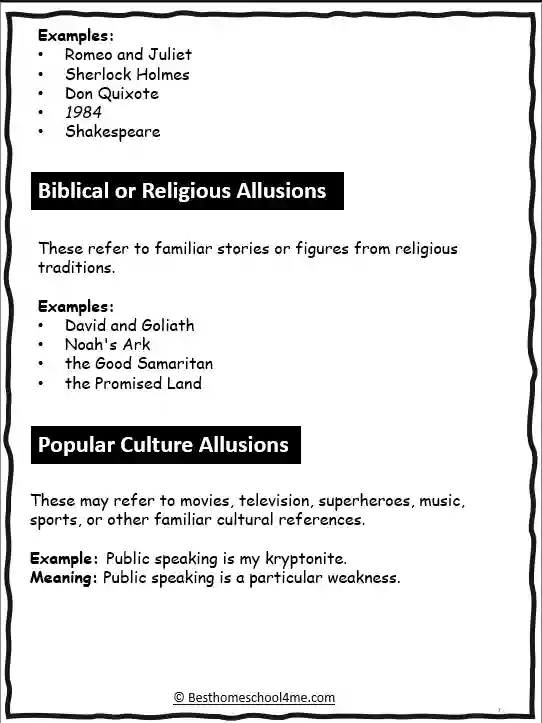
Mythological Allusions
These refer to characters, stories, objects, or events from mythology.
Examples include:
- Achilles’ heel
- Pandora’s box
- Midas touch
- Trojan horse
- Herculean task
Historical Allusions
These refer to people or events from history.
Examples include references to:
- George Washington
- Abraham Lincoln
- The American Revolution
- The Great Depression
- The Civil Rights Movement
Literary Allusions
These refer to books, poems, plays, characters, or authors.
Examples include references to:
- Shakespeare
- Romeo and Juliet
- Sherlock Holmes
- Don Quixote
Biblical or Religious Allusions
These refer to stories, people, places, or ideas found in religious texts.
Examples include:
- David and Goliath
- Noah’s Ark
- The Good Samaritan
- The Promised Land
Pop Culture Allusions
Modern writers may refer to familiar movies, television shows, music, superheroes, sports, or other forms of popular culture.
For example:
“That decision was his kryptonite.”
The reference to Superman helps readers understand that something is a person’s weakness.
How to Identify an Allusion
Finding an allusion can be challenging because the author may not announce the reference directly.
Students can use these steps.
Step 1: Look for an Unusual Reference
Pay attention when a sentence mentions a famous person, character, place, story, or event in an unexpected way.
Step 2: Ask What the Reference Reminds You Of
Does the word or phrase connect to a book, myth, historical event, movie, famous person, or cultural story?
Step 3: Identify the Original Source
Try to determine what the writer is referring to.
Step 4: Explain the Connection
Ask why the author chose that particular reference.
Step 5: Explain the Meaning in Context
Do not stop at naming the reference. Explain what the allusion means in the sentence or passage.
For example:
Sentence: “That difficult assignment was my Mount Everest.”
A strong student response would not simply say: “Mount Everest.”
A better response would be: “The writer alludes to Mount Everest to show that the assignment seemed extremely difficult and challenging.”
That final step is especially important when students are answering reading comprehension questions about allusions.
Allusion vs. Metaphor
Allusion and metaphor can sometimes appear together, but they are not the same thing.
A metaphor directly compares one thing to another.
An allusion refers indirectly to something familiar.
For example: “My homework was a mountain.”
This is a metaphor because the homework is compared to a mountain.
Now consider: “My homework felt like Mount Everest.”
The reference to Mount Everest can function as an allusion because it brings a specific, familiar mountain and its reputation for difficulty to mind.
Understanding this difference helps students analyze figurative language more accurately.
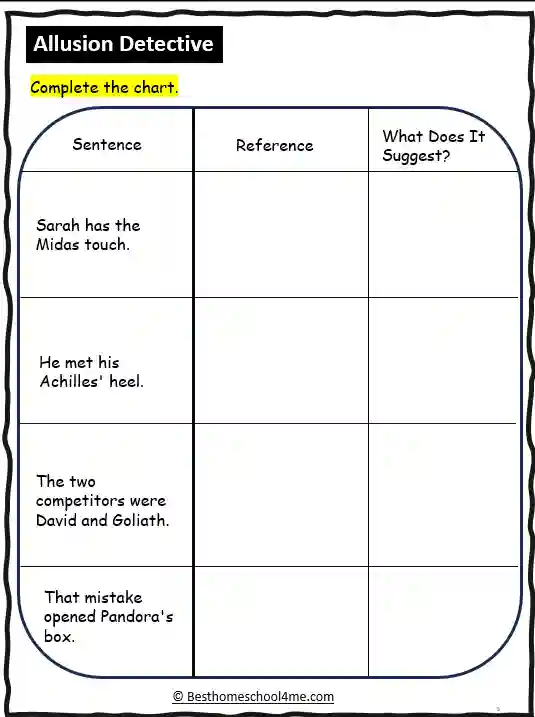
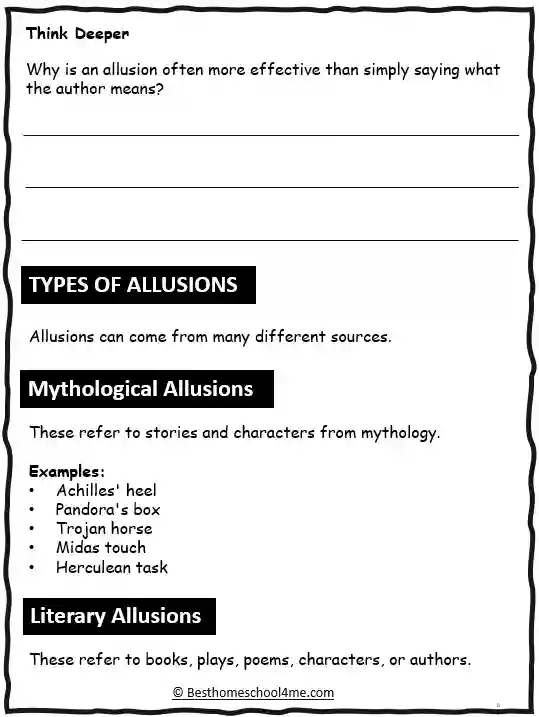
Printable Allusion Worksheet Pdf
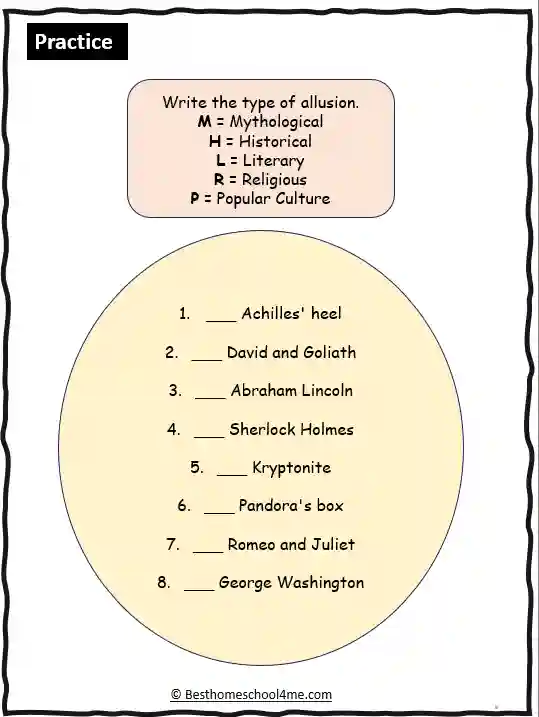
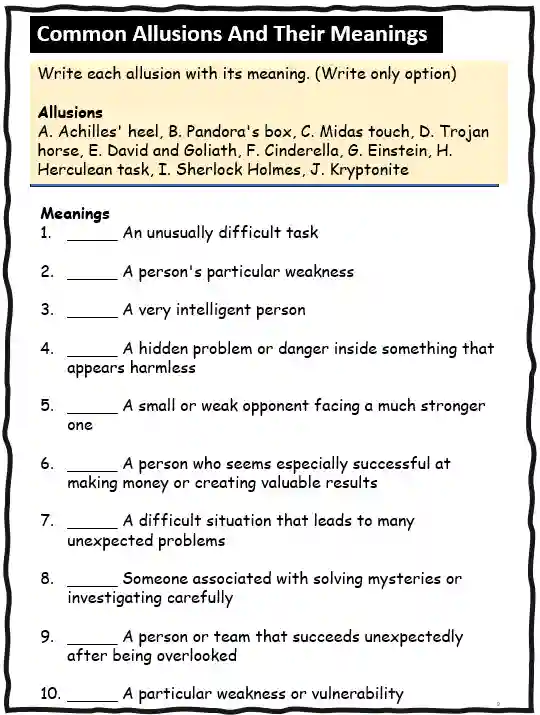
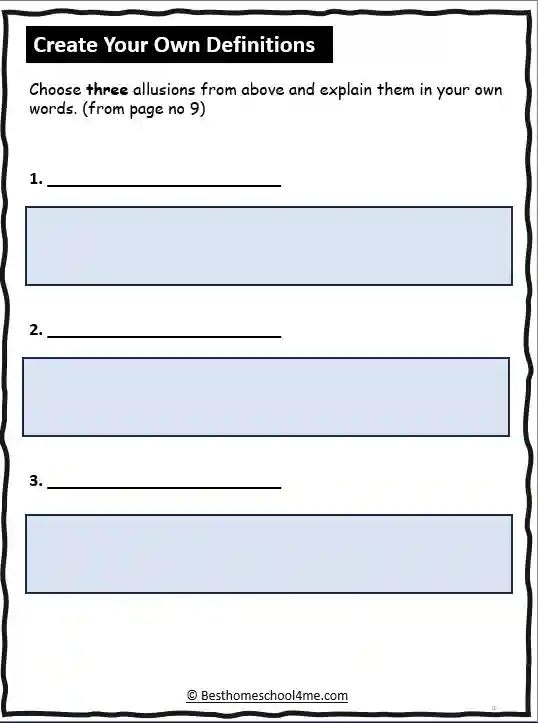
This printable allusion worksheet includes clear definitions, common allusion examples, literary and mythological references, and guided identification practice. Students strengthen figurative language skills through context clues, reading passages, multiple-choice questions, and short-answer activities. It also includes allusion vs. metaphor and illusion practice, creative writing exercises, and a complete answer key for Grades 5–10.
Explore More Worksheets-
- Practice cursive writing step by step with free printable worksheets
- Free Printable Double Entendre Worksheets
- Cursive writing practice sheets from full paragraphs
- Uppercase and Lowercase Cursive Alphabets Writing Worksheets
- All Lowercase Cursive Letters a To z Writing Worksheets
- All Uppercase Cursive Letters A To Z Writing Worksheets
- Download ALL *LATEST* Practice Sheets For Kids
- Master Cursive Writing with These Fun Worksheets!
- *ALL New* Cursive Writing Paragraph sheets For kids for Kids Learning Writing
- Explore Printable Personal Goal Development Worksheets
- Download Free Fruit of the Spirit: Faithfulness Worksheets and make learning God’s Word fun for kids!
- Native American cultural coloring printables for elementary students
- Snow Leopard Worksheets: Facts, Habitats & Adaptations
Frequently Asked Questions
What are printable allusion worksheets?
Printable allusion worksheets help students learn how to identify, interpret, and explain allusions in sentences and reading passages. They typically include allusion definitions, examples, context clues, literary references, and practice questions.
What grade levels are these allusion worksheets suitable for?
These allusion worksheets are suitable for Grades 5–10, with activities that progress from basic allusion identification to more advanced interpretation and literary analysis. They can be used in classrooms, homeschool lessons, or independent English language arts practice.
What skills do students practice with an allusion worksheet?
Students practice identifying allusions, recognizing their original sources, explaining meaning in context, and analyzing why an author uses a particular reference. The activities also strengthen figurative language and reading comprehension skills.
What types of allusion examples are included in the worksheets?
The worksheets include familiar mythological, historical, literary, biblical, and popular culture allusion examples. Students work with references such as Achilles’ heel, Pandora’s box, David and Goliath, Cinderella, Sherlock Holmes, and other commonly encountered allusions.