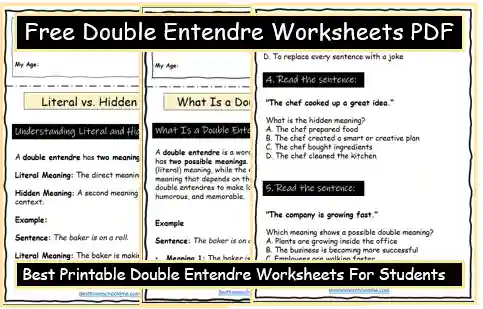
Have you ever read a sentence that seemed to have two different meanings? That’s exactly what makes a double entendre so interesting. A double entendre is a figure of speech or expression that can be understood in two ways- one meaning is straightforward, while the other is often clever, humorous, or requires readers to think more carefully about the context. Learning to recognize double meanings helps students become stronger readers, writers, and critical thinkers.
Many students struggle with double entendres because they naturally focus on the literal meaning of words and may overlook the hidden or implied interpretation. Since understanding a double entendre depends heavily on context, vocabulary, and language awareness, it can be challenging for both native English speakers and English language learners.
That’s where double entendre worksheets make a real difference. Instead of simply memorizing definitions, students practice identifying multiple meanings, analyzing context clues, and applying what they’ve learned through engaging activities. These hands-on exercises build confidence while making figurative language more enjoyable and easier to understand.
What Is a Double Entendre?
A double entendre is a word, phrase, or sentence that has two possible meanings. One meaning is clear and easy to understand, while the second meaning is hidden and depends on the context. The second meaning may be humorous, clever, or thought-provoking, encouraging readers to look beyond the literal words.
Unlike ordinary expressions, a double entendre is intentionally written so that it can be interpreted in more than one way. Writers often use this literary device to add humor, create suspense, or make their writing more memorable.
Simple Definition:
A double entendre is an expression that can be understood in two different ways. The first meaning is clear and direct, while the second meaning requires readers to think about the context.
Example
Sentence: The baker is on a roll.
Literal Meaning: The baker is making bread rolls.
Hidden Meaning: The baker is doing very well or enjoying a streak of success.
Literal Meaning vs. Hidden Meaning
| Literal Meaning | Hidden Meaning |
| The direct meaning of the words. | An implied meaning based on context. |
| Easy to understand. | Requires a little more thought. |
| States exactly what is happening. | Adds humor, creativity, or deeper meaning. |
Double Entendre vs. Pun vs. Idiom vs. Innuendo
These literary devices may seem similar because they all involve language and meaning, but they are used in different ways. Understanding the differences helps students recognize figurative language more accurately.
| Term | Meaning | Example |
| Double Entendre | A phrase with two possible meanings- one literal and one implied. | The baker is on a roll. |
| Pun | A joke that plays on words with similar sounds or multiple meanings. | I used to be a baker, but I couldn’t make enough dough. |
| Idiom | A common expression whose meaning is different from the literal words. | Break the ice (start a conversation). |
| Innuendo | An indirect or subtle hint that suggests something without stating it clearly. | She hinted that he wasn’t telling the whole truth. |
Why Writers Use Double Entendres
Double entendres make writing more engaging because they invite readers to discover an additional layer of meaning. They are commonly used in literature, entertainment, advertising, and everyday conversation to make language more memorable.
To Create Humor
Many jokes rely on words or phrases that have two meanings. The unexpected hidden meaning often surprises readers or listeners, making the joke more enjoyable.
Example:
“The bakery hired more staff because business was on a roll.”
The phrase “on a roll” refers both to doing well and to bread rolls, creating a playful joke.
1. To Add Wordplay
Double entendres make language more creative by allowing a single phrase to express two ideas at once. This type of wordplay keeps readers interested and encourages careful reading.
Example:
“Time flies like an arrow.”
The sentence invites readers to think about more than one possible interpretation, making it memorable.
2. To Make Creative Writing More Interesting
Authors use double entendres to give dialogue and descriptions extra depth. Readers who recognize the hidden meaning often gain a richer understanding of the story or character.
Whether in short stories, novels, or poetry, this literary device adds personality and creativity to writing.
3. To Enrich Literature
Classic and modern authors frequently include double entendres to develop themes, reveal character traits, or add subtle humor. Readers are encouraged to analyze the text carefully instead of accepting only the literal meaning.
This is one reason double entendres are often studied in middle school, high school, and college English classes.
4. To Make Advertising More Memorable
Advertisers often use double meanings to create catchy slogans that stay in people’s minds. A clever phrase can communicate a product’s message while entertaining the audience.
For example, a slogan may use a word with two meanings so customers remember the brand long after seeing the advertisement.
Because of their creativity and impact, double entendres are widely used in marketing, headlines, and promotional campaigns.
Why Students Should Learn Double Entendres
Learning double entendres helps students become stronger readers, writers, and critical thinkers. By understanding both the literal and hidden meanings of words, students improve their reading comprehension, develop problem-solving skills, and learn to recognize context clues. This knowledge also makes creative writing more engaging, helps students better understand literature, and encourages them to appreciate the fun and creativity of the English language.
Who Can Use These Worksheets?
- Middle School Students
- High School Students
- ESL Learners
- Homeschool Families
- English Teachers
- Tutoring Programs
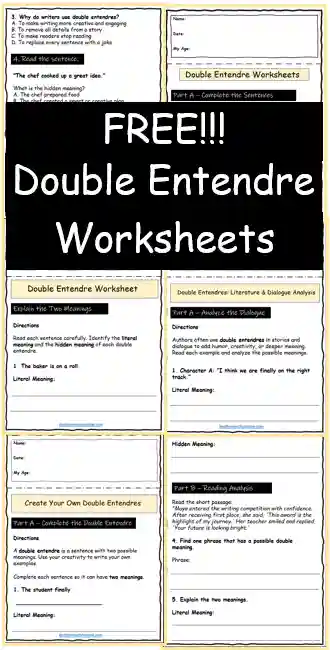
Double Entendre Worksheets: 3 Learning Levels
These double entendre worksheets are divided into three levels – to help students learn step by step. Each level builds confidence by moving from basic understanding to deeper analysis and creative use of double meanings.
Double Entendre Worksheets For Beginners
Students learn the basics of double entendres, including definitions, literal meanings, hidden meanings, and simple examples.
What Is a Double Entendre?
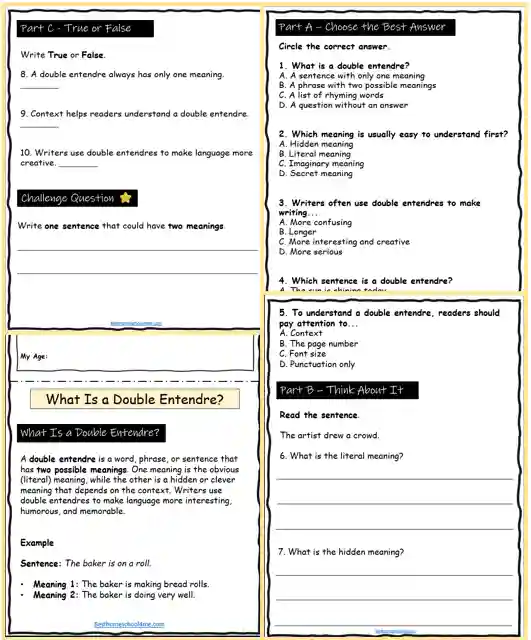
Literal vs. Hidden Meaning
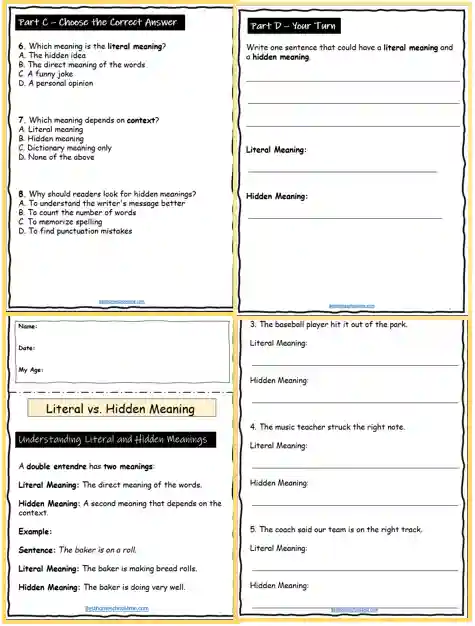
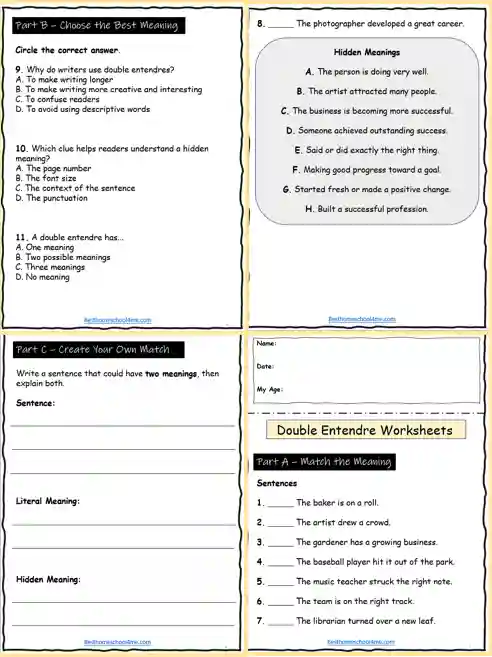
Match the Double Entendre Meaning
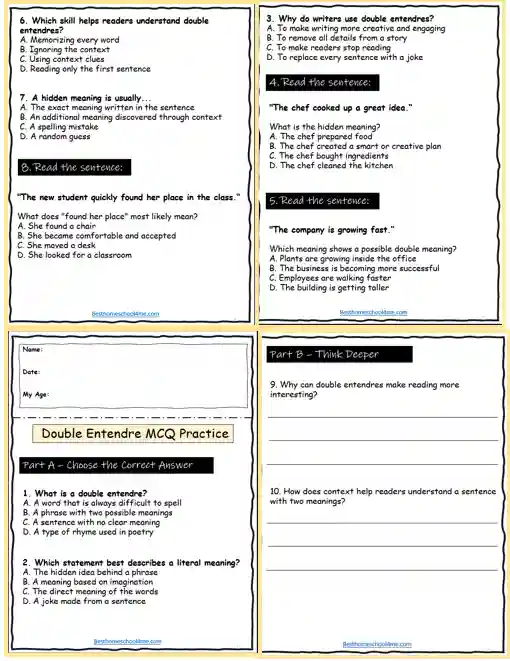
Double Entendre Multiple Choice Practice
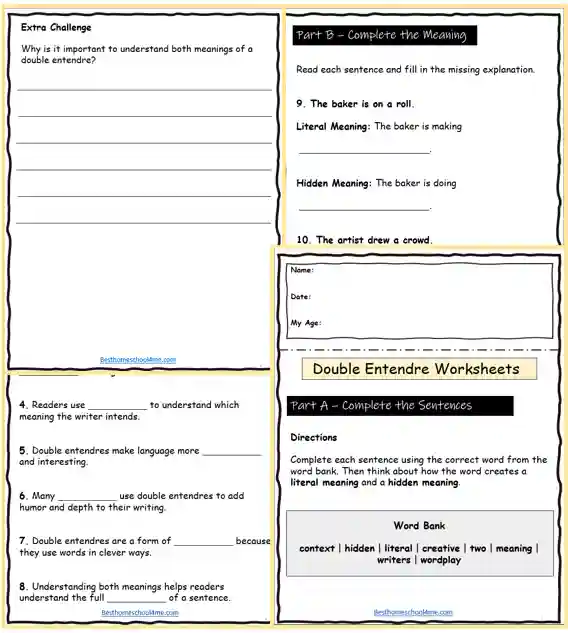
Double Entendre Fill in the Blank
Intermediate Level Double Entendre Worksheets
Students practice identifying double meanings, using context clues, and explaining how phrases can have different interpretations.
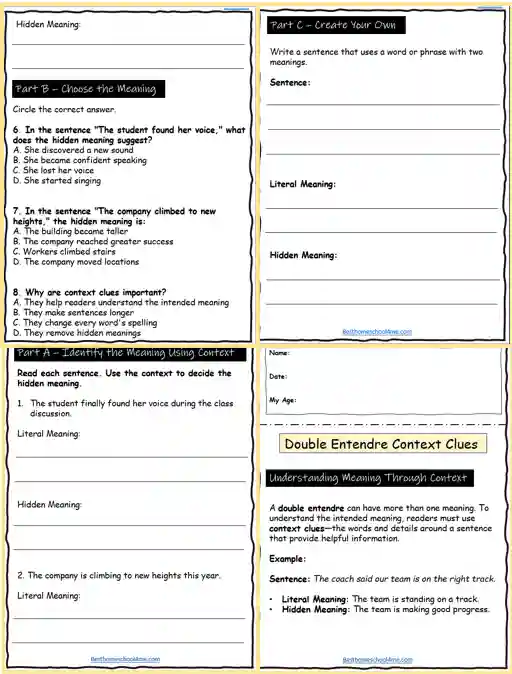
Double Entendre Context Clues
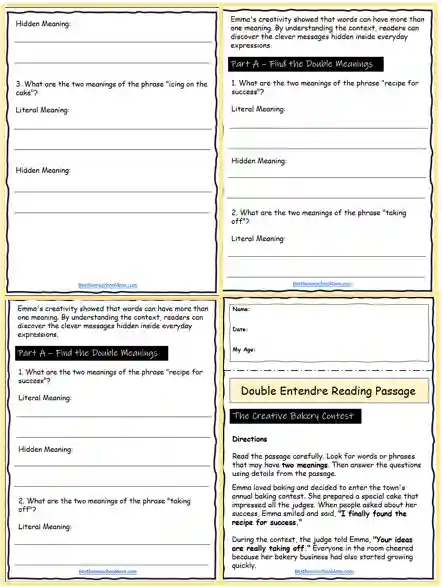
Double Entendre Reading Passage
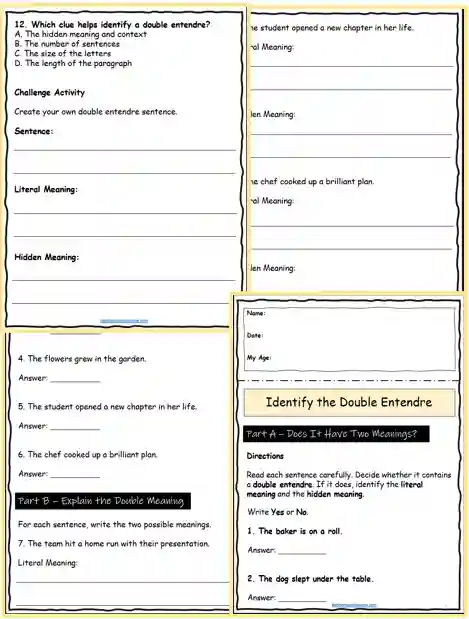
Identify the Double Entendre
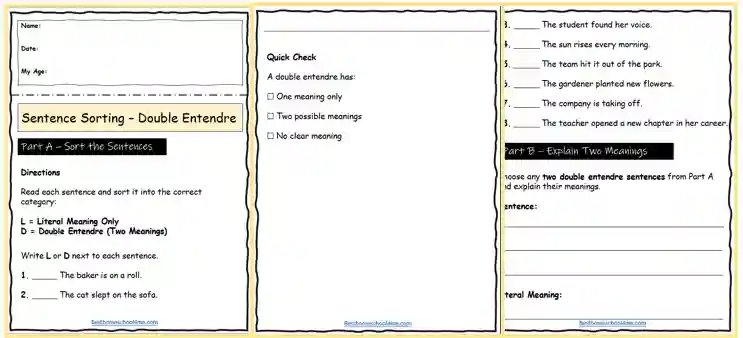
Sentence Sorting – Double Entendre
Explain the Two Meanings
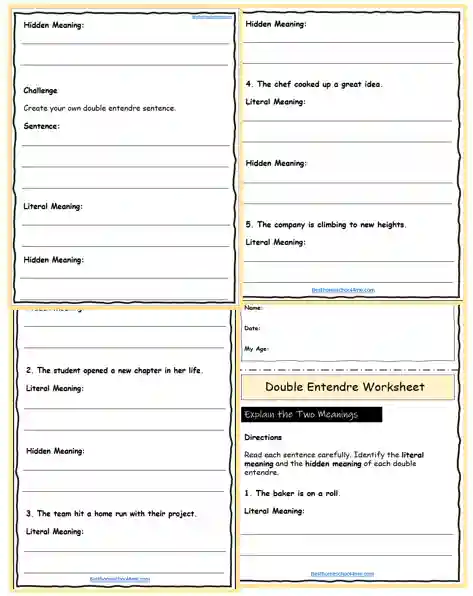
Double Entendre Worksheets for Advanced Learners
Students analyze double entendres in writing, literature, and dialogue while creating their own examples.
Rewrite the Sentence – Double Entendre Practice
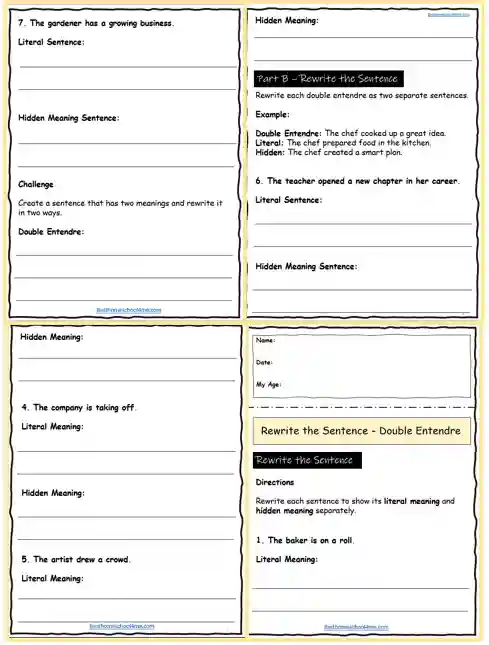
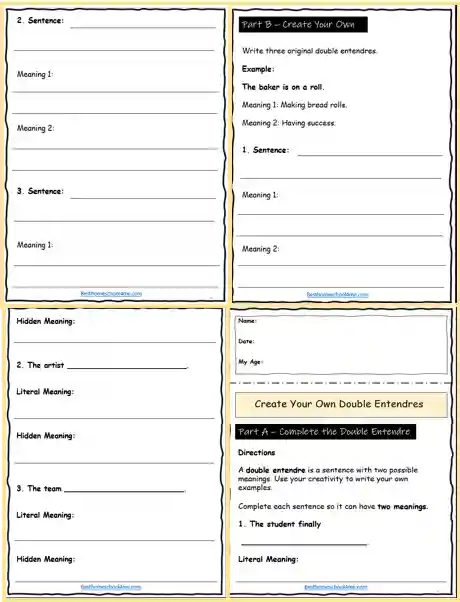
Create Your Own Double Entendres
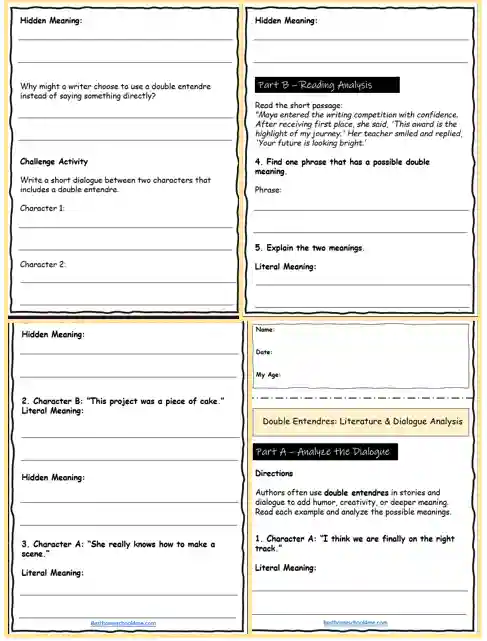
Literature & Dialogue Analysis
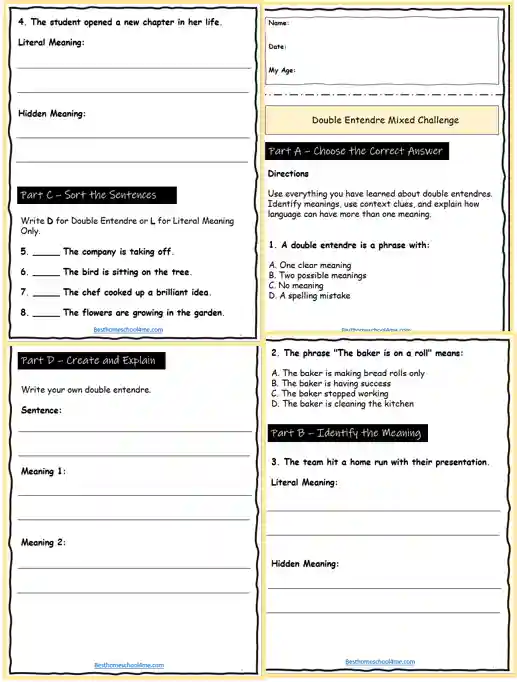
Double Entendre Mixed Challenge
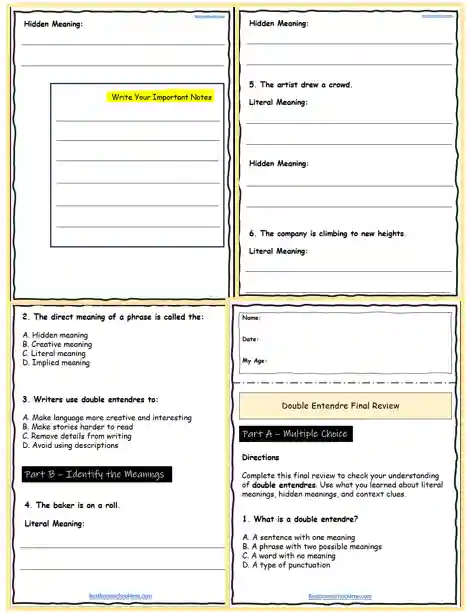
Double Entendre Final Review
NOTE: Need the answers? Visit the bottom of this article to find the complete Double Entendre Worksheets answer key.
Tips for Teaching Double Entendres
Teaching double entendres becomes easier when students start with simple examples and learn to identify the difference between literal and hidden meanings. Teachers should focus on context clues, encourage discussions about multiple interpretations, and help students understand how word choices change meaning. Creative writing activities can also motivate students to create their own examples and improve their language skills.
Common Mistakes Students Make
When learning double entendres, students often make a few common mistakes. They may take every sentence literally, confuse puns with double entendres, ignore important context clues, or miss the hidden meaning completely. Encouraging students to read carefully and think about both possible meanings can help them avoid these mistakes and improve their understanding of figurative language.
Explore More Worksheets-
- Practice cursive writing step by step with free printable worksheets
- Printable Allusion Worksheets for Students
- Cursive writing practice sheets from full paragraphs
- Printable Analogy Worksheets for Kids and Elementary Students
- Uppercase and Lowercase Cursive Alphabets Writing Worksheets
- All Lowercase Cursive Letters a To z Writing Worksheets
- All Uppercase Cursive Letters A To Z Writing Worksheets
- Download ALL *LATEST* Practice Sheets For Kids
- Master Cursive Writing with These Fun Worksheets!
- *ALL New* Cursive Writing Paragraph sheets For kids for Kids Learning Writing
- Explore Printable Personal Goal Development Worksheets
- Download Free Fruit of the Spirit: Faithfulness Worksheets and make learning God’s Word fun for kids!
- Native American cultural coloring printables for elementary students
Frequently Asked Questions-
What are double entendre worksheets, and how do they help students?
Double entendre worksheets help students learn how to identify literal and hidden meanings in words and phrases. Through printable activities, reading passages, and practice exercises, students improve their reading comprehension, critical thinking, and creative writing skills while gaining a better understanding of figurative language.
What grade level are these double entendre worksheets designed for?
These double entendre worksheets are best suited for Grades 6–12, including middle school students, high school students, ESL learners, homeschool families, and English Language Arts (ELA) classrooms. The activities are organized from beginner to advanced levels, making them suitable for different learning abilities.
How can teachers use double entendre worksheets in the classroom?
Teachers can use double entendre worksheets for independent practice, partner activities, group discussions, bell ringers, homework, and formative assessments. They are also useful for teaching figurative language, improving context clue skills, and encouraging students to think critically about multiple meanings in English.
Answer Keys-
What Is a Double Entendre Answer Key
Literal vs. Hidden Meaning Answer Key
Double Entendre Multiple Choice Practice Answer Key
Double Entendre Fill in the Blank Answer Key
Double Entendre Context Clues Answer Key
Double Entendre Reading Passage Answer Key
Identify the Double Entendre Answer Key
Sentence Sorting – Double Entendre Answer Key
Explain the Two Meanings Answer Key
Rewrite the Sentence – Double Entendre Practice Answer Key
Create Your Own Double Entendres Answer Key
Literature & Dialogue Analysis Answer Key
Double Entendre Mixed Challenge Answer Key
Double Entendre Final Review Answer Key