

Explore the fascinating world of one of the most elusive mountain animals with these Snow Leopard Worksheets for Kids. Snow leopards are remarkable wild cats known for their thick spotted coats, powerful legs, wide paws, and long tails that help them survive in some of the coldest and most rugged mountain environments in Central and South Asia.
These snow leopard worksheets give children an engaging way to learn about snow leopard habitat, physical adaptations, diet, behavior, life cycle, and conservation. Through age-appropriate reading passages and activities, students can strengthen their science vocabulary, reading comprehension, observation skills, and understanding of animal adaptations.
Designed for elementary science lessons, homeschool learning, classroom activities, science centers, and independent practice, these printable activities make wildlife education more interactive. Students can discover how snow leopards survive in steep, snowy landscapes while developing a greater appreciation for mountain ecosystems and wildlife conservation.
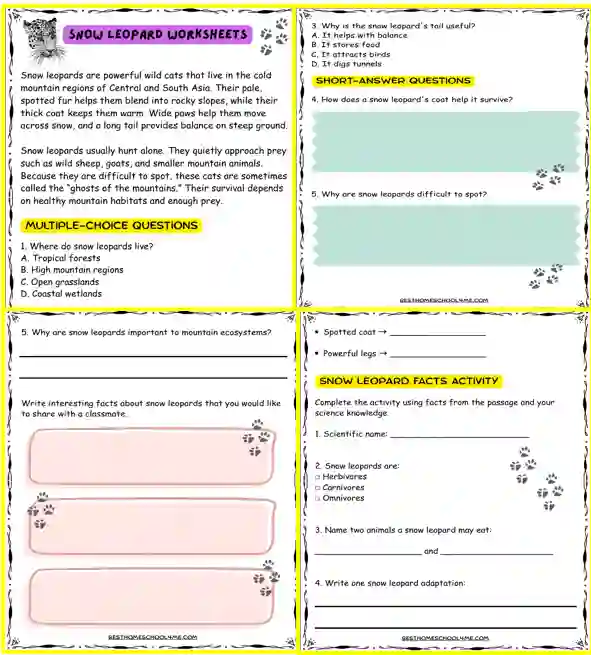
What’s Included in the Snow Leopard Worksheets?
- Reading comprehension passage
- Multiple-choice questions
- Short-answer questions
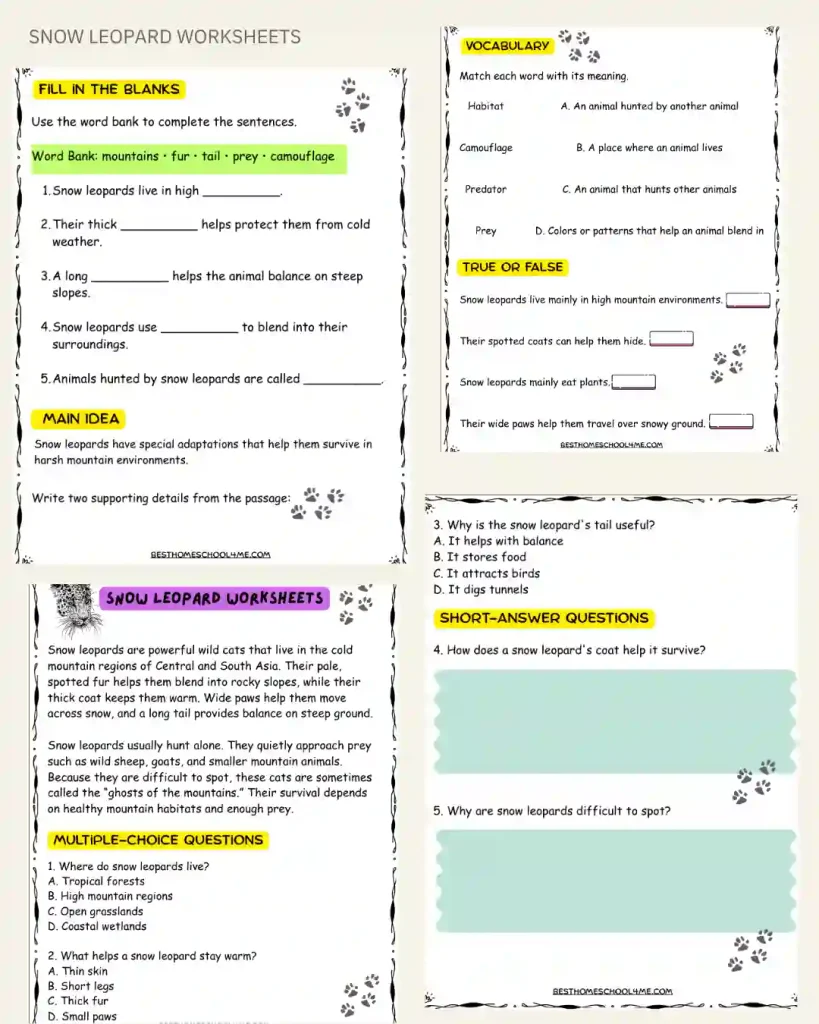
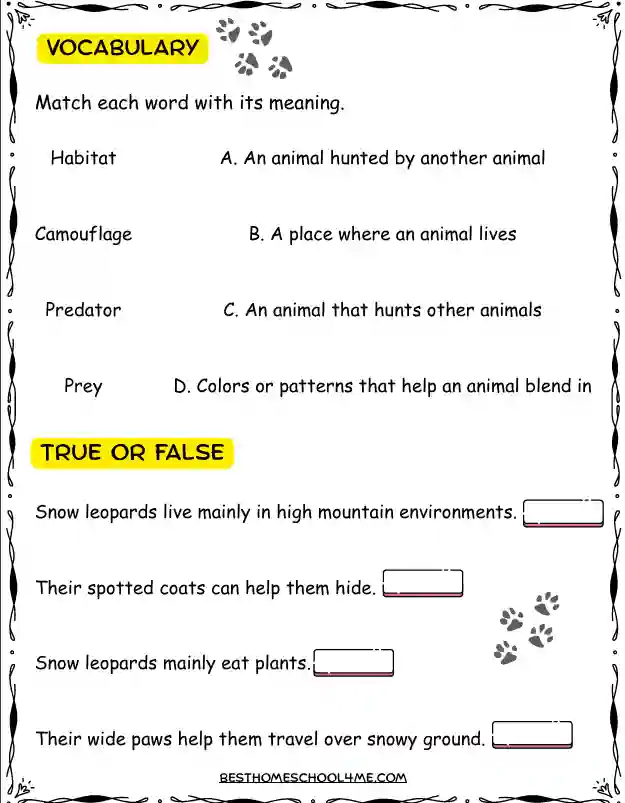
- Vocabulary activity
- True or false
- Fill-in-the-blanks
- Main idea and supporting details
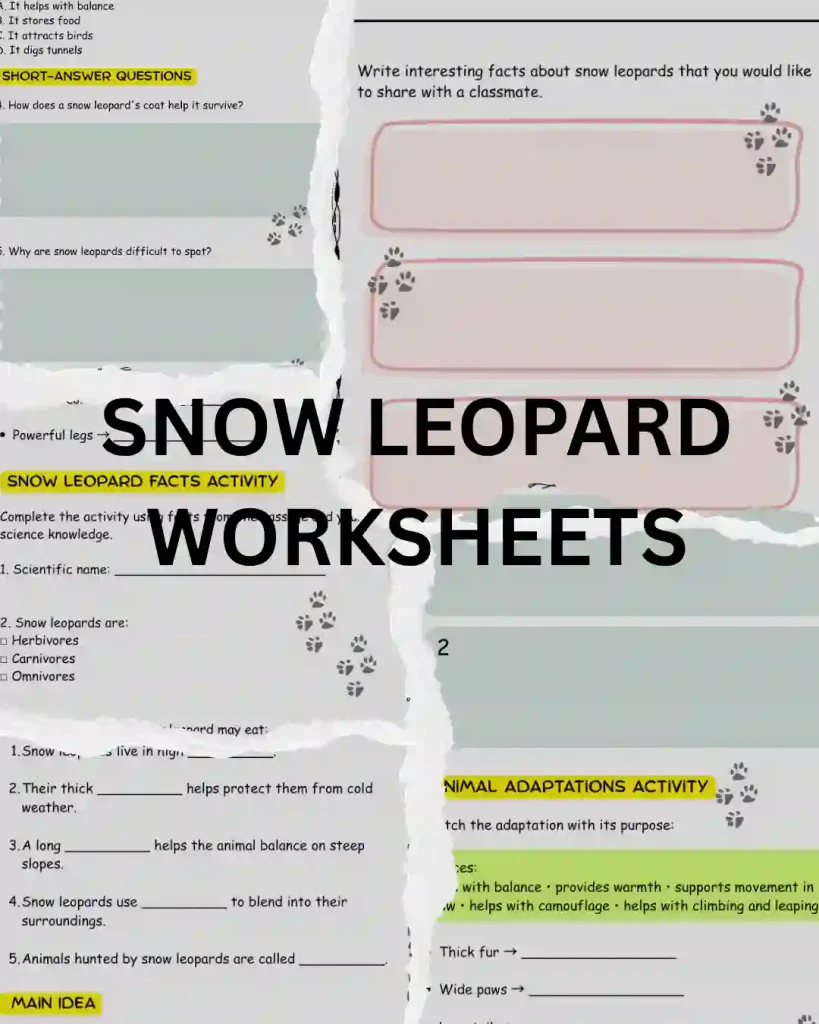
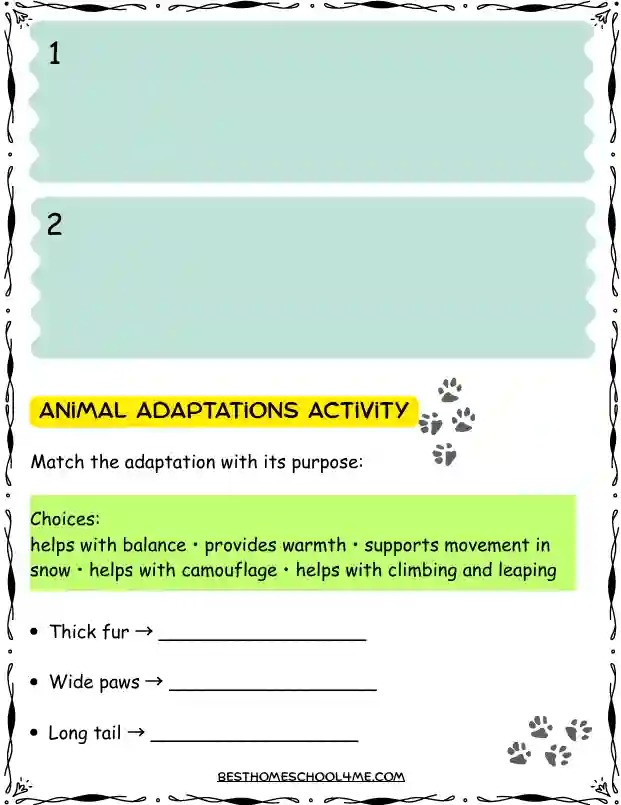
- Animal adaptations activity
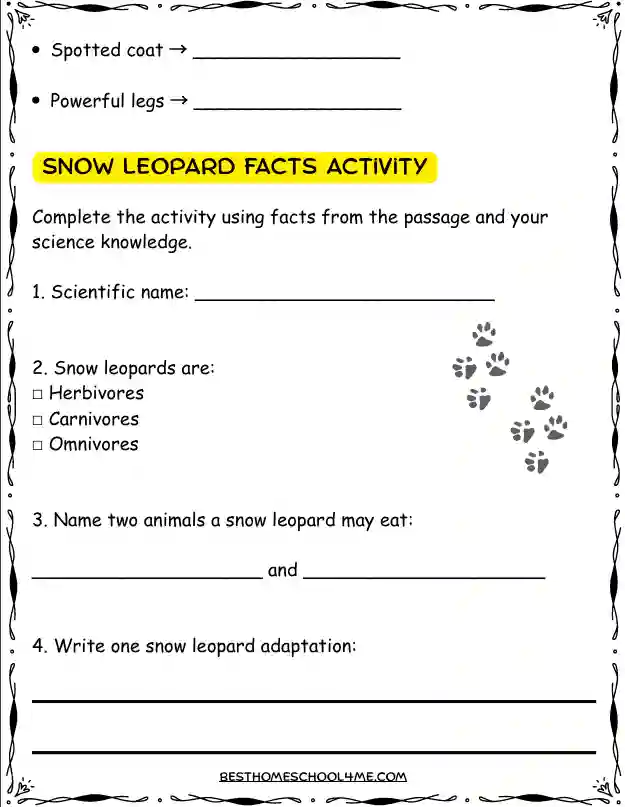
- Snow leopard facts activity
What Is a Snow Leopard?
The snow leopard is a remarkable wild cat specially adapted to life in cold, high-altitude mountains. Its scientific name is Panthera uncia. Unlike many other big cats, snow leopards are rarely seen because they are solitary, cautious animals that blend remarkably well into their rocky surroundings.
Physical Appearance
Snow leopards have a thick, smoky-gray to pale coat covered with dark rosettes and spots. Their dense fur provides insulation against freezing mountain temperatures, while their relatively short face and small rounded ears help reduce heat loss. Their large paws are covered with fur, helping them move across snow and rocky ground.
Size and Weight
An adult snow leopard generally measures about 90–120 cm (35–47 inches) in head-and-body length, with its long tail adding another 80–100 cm (31–39 inches). Adults commonly weigh approximately 25–55 kg (55–121 pounds), although size can vary between individuals and regions.
Distinctive Features
One of the most recognizable snow leopard adaptations is its long, thick tail, which helps with balance when navigating steep slopes and can also be wrapped around the body for warmth. Powerful hind legs allow the animal to leap across rocky terrain, while its broad, furry paws work like natural snowshoes.
Where Do Snow Leopards Live?
Snow leopards inhabit rugged mountain landscapes across parts of Central and South Asia, including the Himalayas and other high mountain ranges. They are associated with rocky cliffs, alpine meadows, steep valleys, and sparsely vegetated slopes. Their specialized adaptations allow them to survive in environments where temperatures can become extremely cold.
These characteristics make the snow leopard an excellent subject for snow leopard worksheets for kids, especially activities about snow leopard physical adaptations, snow leopard habitat, animal characteristics, and mountain wildlife.
Snow Leopard Habitat
Snow leopards live in rugged high-altitude mountain habitats across the Himalayas and parts of Central Asia. They are found among rocky slopes, steep cliffs, alpine meadows, and cold valleys where temperatures can drop sharply.
Their thick fur helps protect them from freezing weather, while broad, furry paws provide traction on snow and rocky ground. A long tail helps with balance and can provide extra warmth when wrapped around the body.
Snow Leopard Adaptations
Snow leopards have specialized features that help them survive in cold, rocky mountain habitats.
- Thick Fur: Keeps their bodies warm in freezing conditions.
- Long Tail: Provides balance on steep slopes and extra warmth.
- Wide Paws: Help them walk across snow and rough terrain.
- Powerful Legs: Allow them to climb and leap across rocky mountains.
- Large Nasal Passages: Help warm cold air before it reaches the lungs.
- Camouflage: Their spotted coat blends with rocks and snowy surroundings.
These snow leopard adaptations for kids are ideal for learning about animal survival adaptations and mountain wildlife.
What Do Snow Leopards Eat?
Snow leopards are carnivorous mountain predators that mainly eat other animals. Their diet can include wild sheep, mountain goats, marmots, pikas, hares, and birds, depending on what is available in their habitat.
They use stealth and camouflage to approach prey quietly. Their powerful legs help them navigate steep slopes and make sudden leaps during a hunt. This makes their feeding habits a useful topic for snow leopard diet worksheets, snow leopard food chain activities, and animal science lessons for kids.
Snow Leopard Life Cycle
The snow leopard life cycle begins when adults mate during the breeding season. After a pregnancy of roughly three months, the female gives birth to a small litter of cubs in a sheltered rocky den.
Snow leopard cubs remain dependent on their mother as they grow. She provides food, protection, and guidance until they become more capable of moving and hunting on their own. As young snow leopards mature, they gradually develop the strength and skills needed for independent life in the mountains.
Snow Leopard Conservation
Snow leopards face threats from habitat loss, reduced prey, climate change, and human-wildlife conflict. Changes in mountain landscapes can make it harder for these elusive cats to find food and safe areas to live.
Conservation programs focus on protecting mountain habitats, supporting local communities, safeguarding prey species, and reducing conflicts between people and wildlife. Protecting healthy mountain ecosystems also benefits many other plants and animals.
Snow Leopard Facts for Kids
- Snow leopards are wild cats that live in high mountain regions.
- Their scientific name is Panthera uncia.
- Snow leopards have thick fur that helps them stay warm.
- Their spotted coats provide excellent camouflage among rocks and snow.
- A long, furry tail helps them balance on steep slopes.
- Their wide paws help them travel across snowy ground.
- Snow leopards can make powerful leaps across rocky terrain.
- They mainly eat wild sheep, goats, and smaller mountain animals.
- Snow leopards usually live and hunt alone.
- They are well adapted to cold, rugged environments.
- Snow leopard cubs stay with their mothers while they develop important survival skills.
- Snow leopards can be difficult to spot because their natural camouflage is so effective.
- They play an important role in maintaining healthy mountain ecosystems.
- Snow leopards are threatened by habitat loss and other human-related pressures.
- Protecting mountain habitats helps support snow leopards and other wildlife.
Who Can Use These Worksheets?
- Elementary students
- Teachers
- Homeschool families
- Science classrooms
- Substitute teachers
- Animal-study units
- Independent practice
Snow Leopard Worksheets: Wildlife Facts & Activities
Students will explore snow leopard habitat, diet, adaptations, behavior, and conservation through engaging science-based activities.
The worksheets include reading comprehension, vocabulary, multiple-choice, true-or-false, and fill-in-the-blank exercises.
Children will also practice identifying the main idea and supporting details while learning how snow leopards survive in challenging mountain environments.
A dedicated animal adaptations and snow leopard facts activity reinforces key concepts in an age-appropriate way.
Explore More Worksheets-
- Practice cursive writing step by step with free printable worksheets
- Printable Analogy Worksheets for Kids and Elementary Students
- Free Printable Double Entendre Worksheets
- Cursive writing practice sheets from full paragraphs
- Uppercase and Lowercase Cursive Alphabets Writing Worksheets
- All Lowercase Cursive Letters a To z Writing Worksheets
- All Uppercase Cursive Letters A To Z Writing Worksheets
- Download ALL *LATEST* Practice Sheets For Kids
- Master Cursive Writing with These Fun Worksheets!
- *ALL New* Cursive Writing Paragraph sheets For kids for Kids Learning Writing
- Explore Printable Personal Goal Development Worksheets
- Download Free Fruit of the Spirit: Faithfulness Worksheets and make learning God’s Word fun for kids!
- Native American cultural coloring printables for elementary students
What can children learn from snow leopard worksheets?
Children can learn about snow leopard habitats, diets, adaptations, life cycles, behavior, and conservation. These activities also strengthen reading comprehension, vocabulary, and basic science skills.
2. What age group are snow leopard worksheets suitable for?
These worksheets are well suited for elementary students, particularly children learning about animal habitats, wildlife, ecosystems, and adaptations in science or reading lessons.
What activities are included in snow leopard worksheets?
Activities can include reading comprehension, multiple-choice questions, vocabulary practice, true-or-false statements, fill-in-the-blanks, adaptation activities, and snow leopard fact exercises.
How can teachers use snow leopard worksheets in the classroom?
Teachers can incorporate them into animal science units, wildlife lessons, reading centers, early finisher activities, or independent practice. They also work well for homeschool learning and classroom enrichment.