
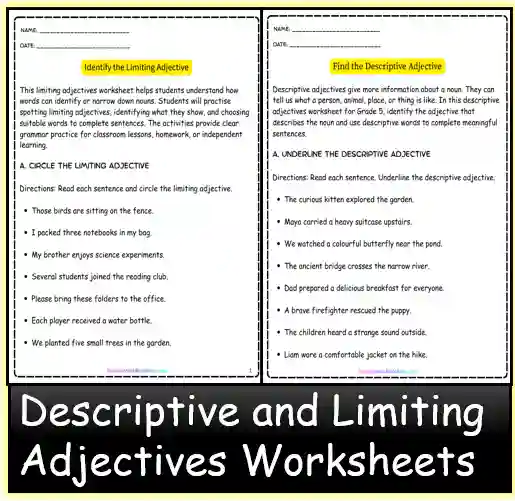
Adjectives help students make their writing clearer, more detailed, and easier to understand. Instead of simply saying “the dog,” a student can write “the playful dog” or “that small dog” to give the reader more information. Descriptive adjectives tell us about the qualities or characteristics of a noun, while limiting adjectives help identify, specify, or narrow down which noun is being discussed.
These Descriptive and Limiting Adjectives Worksheets for Grade 5 provide focused practice with both types of adjectives through engaging grammar activities. Students can strengthen their understanding of descriptive adjectives, limiting adjectives, and adjective usage while building stronger sentences. These Grade 5 adjective worksheets are useful for classroom lessons, homework, tutoring, homeschool practice, and independent learning.
What Are Descriptive Adjectives?
Descriptive adjectives are words that give more information about a noun by telling us what kind, what something looks like, or what quality it has. They help readers create a clearer picture of a person, place, animal, object, or idea.
Examples:
- a sparkling star
- a gentle puppy
- a gigantic castle
- a delicious sandwich
- a cheerful child
In each example, the bold word describes a quality or characteristic of the noun.
What Are Limiting Adjectives?
Limiting adjectives are words that help identify or narrow down a noun. They can tell us which one, how many, how much, or whose noun we mean. Unlike descriptive adjectives, they do not mainly describe a quality; instead, they make the noun more specific.
Examples:
- this book
- three pencils
- my backpack
- each student
- those flowers
- several questions
The bold words limit or specify the nouns they come before.
Common Types of Limiting Adjectives
Limiting adjectives come in different forms. They help make a noun more specific by showing which one, whose, how many, or how much.
- Articles: a, an, the – identify a noun generally or specifically.
Example: the book - Demonstratives: this, that, these, those – point to particular nouns.
Example: those flowers - Possessives: my, your, his, her, our, their – show ownership or connection.
Example: my backpack - Numbers: one, two, five, etc. – tell exactly how many.
Example: five pencils - Quantity Words: many, few, several, enough, etc. – show an amount or quantity.
Example: several questions
Descriptive vs. Limiting Adjectives
Both descriptive and limiting adjectives modify nouns, but they serve different purposes. Descriptive adjectives tell us more about a noun’s qualities, while limiting adjectives help identify or narrow down the noun.
| Descriptive Adjectives | Limiting Adjectives |
|---|---|
| Describe a quality or characteristic | Identify or narrow down a noun |
| Tell what kind, what it looks like, or what it is like | Tell which one, whose, or how many |
| bright, clever, enormous | this, my, three, several |
| a clever student | three students |
| an enormous elephant | those elephants |
If the word describes the noun, it is descriptive. If it specifies or limits the noun, it is limiting.
Get Your Descriptive and Limiting Adjectives Worksheets for Grade 5 Here
This collection provides varied adjective practice to help students identify, classify, and use both types of adjectives correctly. The printable activities move from simple identification tasks to sentence-based and mixed practice, making them suitable for different learning levels.
Teachers can use these Grade 5 adjective worksheets during grammar lessons, while parents, tutors, and homeschool educators can use them for homework, revision, or independent learning. Each worksheet is designed to strengthen grammar skills while helping students write clearer and more specific sentences.
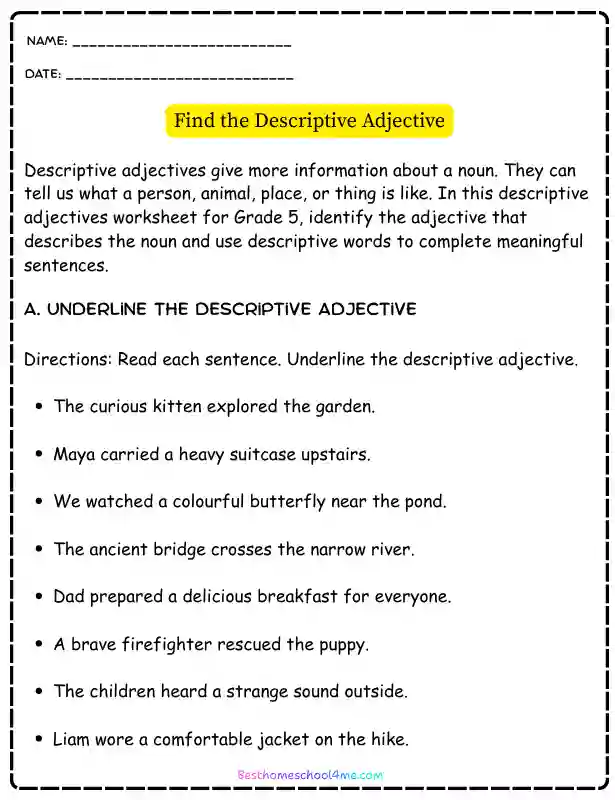
Find the Descriptive Adjective
Help Grade 5 students recognize and use descriptive adjectives with this focused grammar worksheet. Students will identify describing words, match adjectives with the nouns they modify, complete sentences with suitable adjectives, and create their own descriptive sentences. The activities build adjective recognition, vocabulary, and sentence-writing skills through simple and engaging practice.
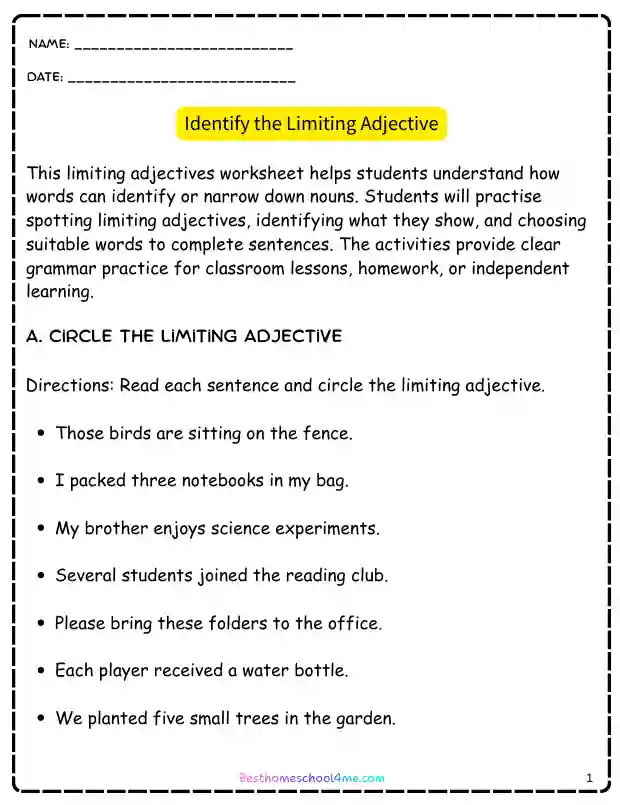
Identify the Limiting
This worksheet helps students recognize limiting adjectives that make nouns more specific. Students will identify limiting adjectives, classify them by what they show, and complete sentences with suitable words. It provides simple, practical practice with possession, numbers, quantities, and words that identify particular nouns.
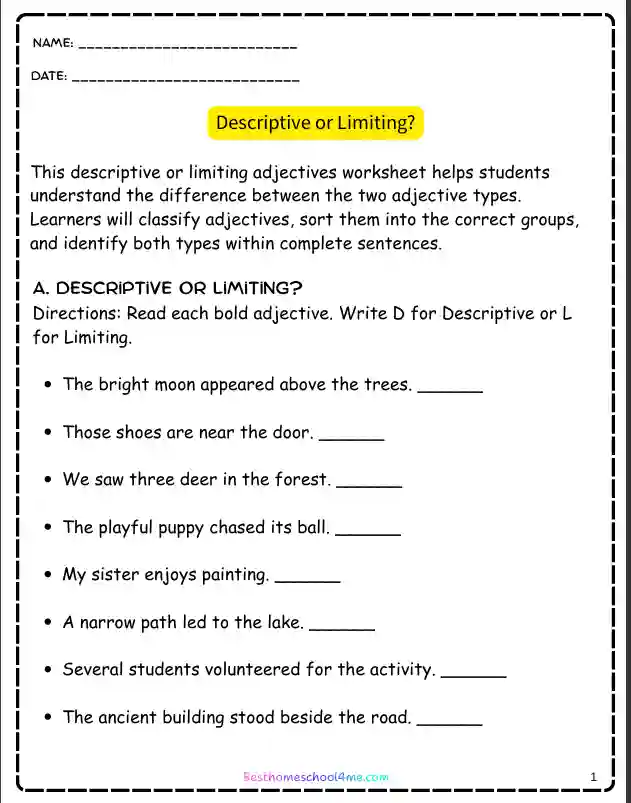
Descriptive or Limiting?
This Grade 5 worksheet gives students focused practice in telling descriptive adjectives apart from limiting adjectives. Students sort and classify adjective words, identify both types in sentences, and create their own examples. It helps reinforce adjective recognition while building stronger grammar and sentence-writing skills.
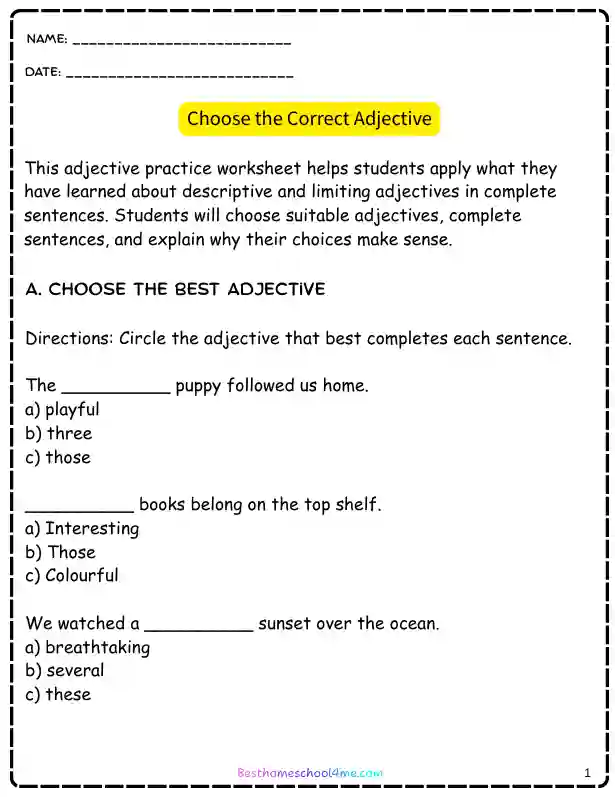
Choose the Correct Adjective
This Grade 5 worksheet helps students apply their knowledge of descriptive and limiting adjectives in meaningful sentences. Students choose suitable adjectives, complete sentences, and explain their choices. The activities encourage students to use context and meaning to select adjectives accurately while strengthening grammar and sentence-building skills.
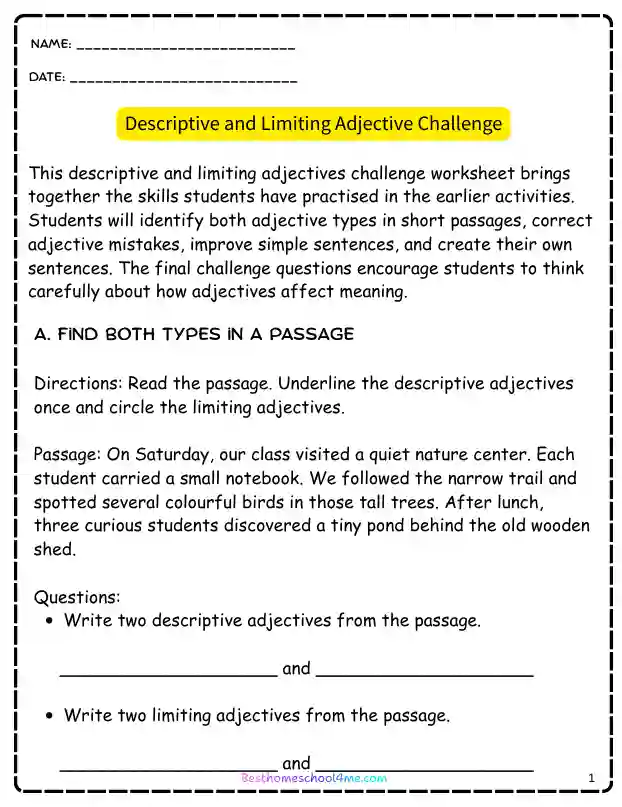
Descriptive and Limiting Adjective Challenge
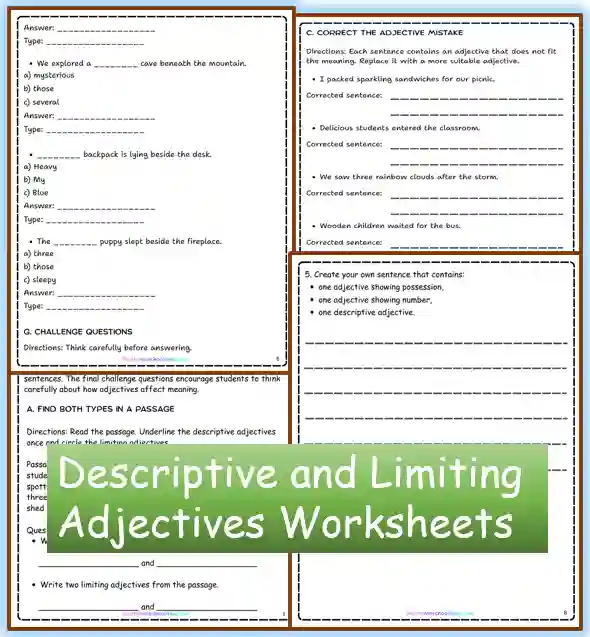
This Grade 5 challenge worksheet provides mixed practice with descriptive and limiting adjectives through passages, sentence correction, rewriting, and creative sentence-building activities. Students apply their grammar knowledge in different contexts while completing higher-level questions that encourage careful thinking and accurate adjective use.
Learning Benefits of These Adjective Worksheets
- Recognise adjectives in sentences
- Distinguish descriptive from limiting adjectives
- Expand vocabulary
- Write more specific sentences
- Strengthen grammar and sentence-building skills
- Apply adjective rules in context
Tips for Teaching Descriptive and Limiting Adjectives
- Start with familiar objects.
- Ask students to describe classroom items.
- Compare “the dog” with “that playful dog.”
- Have students highlight different adjective types.
- Use sentence-building games.
- Move from identification to independent writing.
Common Mistakes Students Make With Adjectives
- Confusing descriptive and limiting adjectives
- Treating every adjective as descriptive
- Missing articles such as a, an, the
- Confusing possessive adjectives with pronouns
- Choosing adjectives that do not fit the noun
- Identifying the noun but overlooking its modifier
Explore More Worksheets-
- Analogy Worksheets
- Free Printable Double Entendre Worksheets
- Allusion Worksheets
- Download ALL *LATEST* Practice Sheets For Kids
- Identify major ways environmental influences contribute to settlement patterns in the United States
- *ALL New* Cursive Writing Paragraph sheets For kids for Kids Learning Writing
- Explore Printable Personal Goal Development Worksheets
Frequently Asked Questions About Descriptive and Limiting Adjectives Worksheets
What are descriptive and limiting adjectives for Grade 5?
Descriptive adjectives tell more about a noun’s qualities, such as bright, gentle, or enormous. Limiting adjectives make a noun more specific by showing which one, whose, or how many, such as this, my, three, or several. Grade 5 students can practise both with adjective worksheets and sentence exercises.
How can students identify descriptive and limiting adjectives in a sentence?
Students can first find the noun and then ask what the adjective does. If it describes a quality or characteristic, it is descriptive. If it identifies or narrows the noun, it is limiting. Practice with descriptive and limiting adjectives worksheets for Grade 5 can make this distinction easier.
Why are adjective worksheets useful for Grade 5 students?
Adjective worksheets give students structured practice in identifying, classifying, and using adjectives correctly. Descriptive and limiting adjectives exercises for Grade 5 can improve grammar, vocabulary, reading comprehension, and sentence-writing skills through practical examples.