
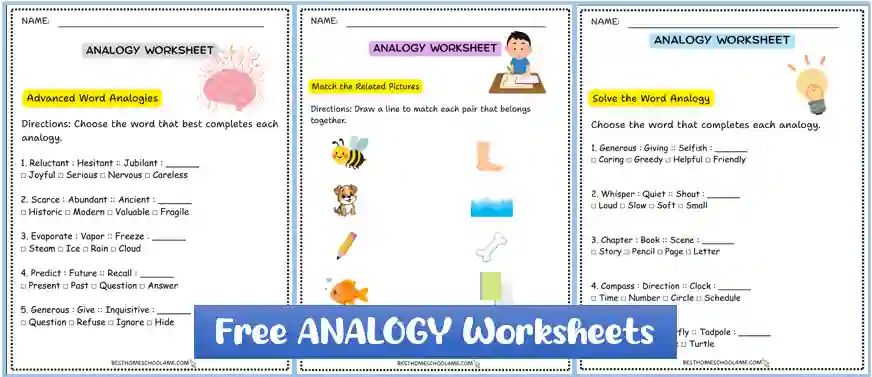
Analogy worksheets help students strengthen vocabulary, recognize word relationships, and develop the reasoning skills they need to understand how ideas connect. In a typical analogy, students examine one pair of words and use the same relationship to complete another pair, such as Bird is to Nest as Dog is to ____. This simple format encourages children to think beyond memorizing definitions and focus on meaning and connections.
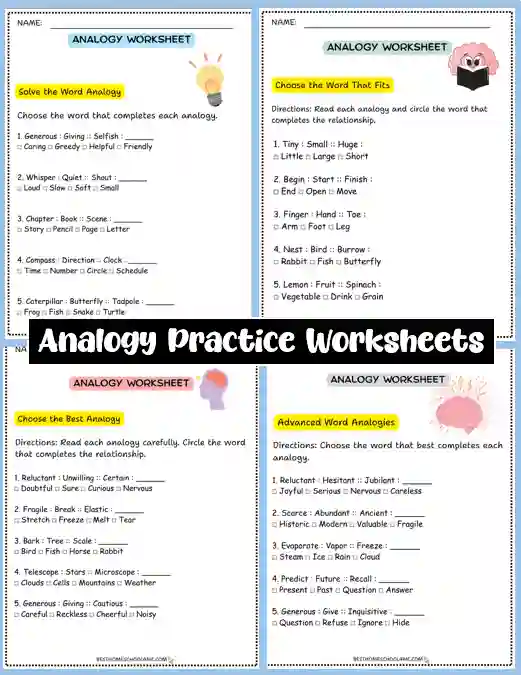
These analogy practice worksheets are designed for elementary students who are building vocabulary and learning to identify relationships such as synonyms, antonyms, parts and wholes, categories, functions, and locations. The activities can support classroom instruction, homeschool lessons, literacy centers, independent practice, or extra vocabulary review.
On this page, you’ll find engaging analogy questions, word relationship activities, printable Analogy practice pages, and answer keys to help students practice at an appropriate level and build confidence one analogy at a time.
What Is an Analogy?
An analogy is a comparison that shows how two pairs of words, objects, or ideas are related in a similar way. Instead of simply asking what a word means, an analogy asks students to think about the connection between two things and then find another pair with the same connection. This makes analogies a useful way to practice vocabulary, logical thinking, and word relationships.
For kids, an analogy can be thought of as a relationship puzzle. Students look at the first pair, figure out what connects them, and then use that same pattern to complete the second pair.
What Does an Analogy Look Like?
Analogies are often written in this format:
A : B :: C : D
The symbol “::” can be read as “is to … as.” For example:
Bird : Nest :: Bee : Hive
A bird lives in a nest, and a bee lives in a hive. The relationship is animal to home.
Hot : Cold :: Up : Down
Hot and cold are opposites, just as up and down are opposites. The relationship is opposite words.
Puppy : Dog :: Kitten : Cat
A puppy is a young dog, just as a kitten is a young cat. The relationship is young animal to adult animal.
When solving analogy questions, students should first identify the relationship in the first pair. Once they understand that connection, they can apply the same idea to the second pair. Practicing different analogy examples helps children become more confident with vocabulary and recognize word relationships more quickly.
How Do You Solve an Analogy?
Solving an analogy becomes much easier when students focus on the relationship between the words instead of trying to guess the missing answer. A good strategy is to turn the first pair into a short sentence, identify what connects the two words, and then look for another pair that follows the same pattern.
Step 1: Look at the First Pair
Start by examining the first two words carefully. Ask yourself, “How are these words connected?” The relationship might show an opposite, a part and its whole, an object and its function, an animal and its home, or another meaningful connection.
For example:
Bird : Nest
A bird and a nest are connected because a nest is a place where a bird lives.
Step 2: Say the Relationship in a Sentence
Turn the connection into a simple sentence. This helps make the relationship easier to recognize and remember.
A bird lives in a nest.
Now you know the relationship you need to look for in the second pair.
Step 3: Apply the Same Relationship
Use the same relationship with the next word.
Bee : Hive
Ask: “Does a bee live in a hive?”
Yes! A bee lives in a hive, so hive completes the analogy.
Bird : Nest :: Bee : Hive
This step-by-step approach helps students solve analogy questions with reasoning rather than guessing. With regular analogy practice, children can become better at recognizing word relationships and applying them to new vocabulary.
Types of Analogies Students Should Know
Not all analogies connect words in the same way. Some compare words with similar meanings, while others show opposites, parts of a whole, functions, locations, or categories. Learning these common types of analogies gives students a useful strategy for solving analogy questions and recognizing relationships between unfamiliar words.
Synonym Analogies
A synonym analogy connects two words that have similar or nearly the same meanings. Students can solve these analogies by asking, “Do these words mean something alike?”
Happy : Joyful :: Sad : ______
The words happy and joyful have similar meanings. Following the same relationship, sad connects with unhappy.
Relationship: similar meaning
Antonym Analogies
An antonym analogy uses words with opposite meanings. To identify this relationship, students can ask, “Are these words opposites?”
Hot : Cold :: Fast : ______
Hot and cold have opposite meanings. In the same way, fast and slow are opposites.
Relationship: opposite meaning
Part-to-Whole Analogies
A part-to-whole analogy shows that one word is a component or piece of something larger. Students should ask, “Is the first word a part of the second?”
Wheel : Car :: Page : ______
A wheel is part of a car. In the same way, a page is part of a book.
Relationship: part to whole
Object-to-Function Analogies
This type of analogy connects an object with the action or purpose it is used for. Ask, “What does this object do?”
Scissors : Cut :: Pencil : ______
Scissors are used to cut, while a pencil is used to write.
Relationship: object to function
Person-to-Workplace Analogies
These analogies connect a person with the place where that person typically works. Students can ask, “Where does this person work?”
Teacher : School :: Doctor : ______
A teacher works at a school. Following the same relationship, a doctor works at a hospital.
Relationship: person to workplace
Animal-to-Habitat Analogies
An animal-to-habitat analogy connects an animal with its usual home or environment. Students should think about where the animal lives.
Bird : Nest :: Bear : ______
A nest is a home or shelter associated with a bird. A bear may live in a den.
Relationship: animal to home
Object-to-Location Analogies
An object-to-location analogy connects something with a place where it is commonly found, stored, or used.
Book : Library :: Plane : ______
Books can be found in a library. In the same way, planes can be found at an airport.
Relationship: object to location
Cause-and-Effect Analogies
A cause-and-effect analogy shows that one event, action, or condition can produce a particular result. Students should ask, “What happens because of this?”
Rain : Wet :: Fire : ______
Rain can make things wet. Fire can make something hot.
Relationship: cause to effect
Category Analogies
Category analogies connect a specific item to the group or class it belongs to. Students can ask, “What larger group does this word belong to?”
Apple : Fruit :: Carrot : ______
An apple is a type of fruit. A carrot is a type of vegetable.
Relationship: item to category
Understanding these common analogy relationships can make analogy worksheets easier to approach. Instead of guessing the missing word, students can identify the relationship first and then look for an answer that follows the same pattern. This builds vocabulary while giving children practice with comparison, classification, and logical reasoning.
Analogy Worksheets for Pre-K
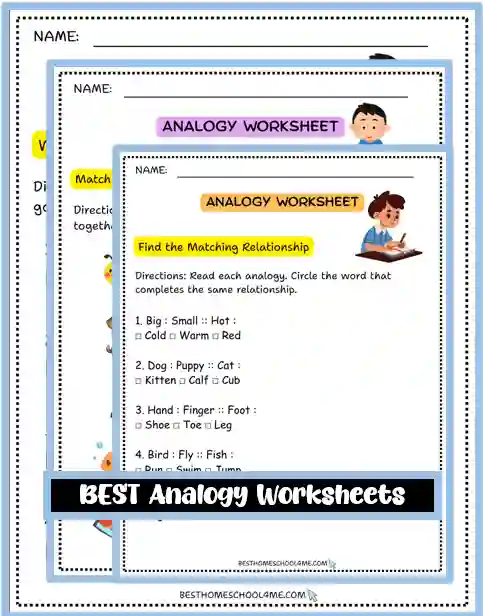
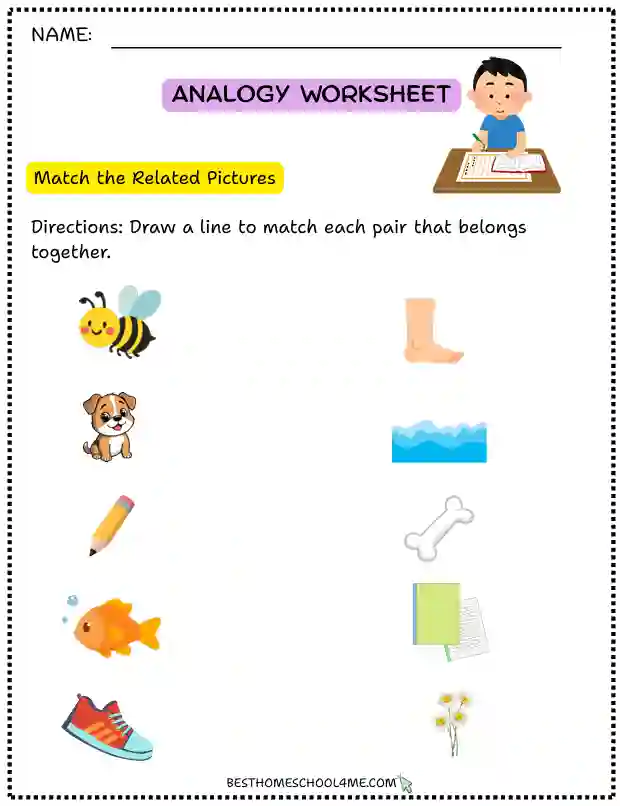
Pre-K students can begin learning analogies by noticing simple relationships between familiar objects, animals, actions, and everyday ideas. These analogy worksheets for prek use short prompts and child-friendly comparisons to help young learners practice matching things that belong together. The activities are designed to introduce early reasoning and word-relationship skills without overwhelming beginning learners.
Analogy Worksheets for Grade 1
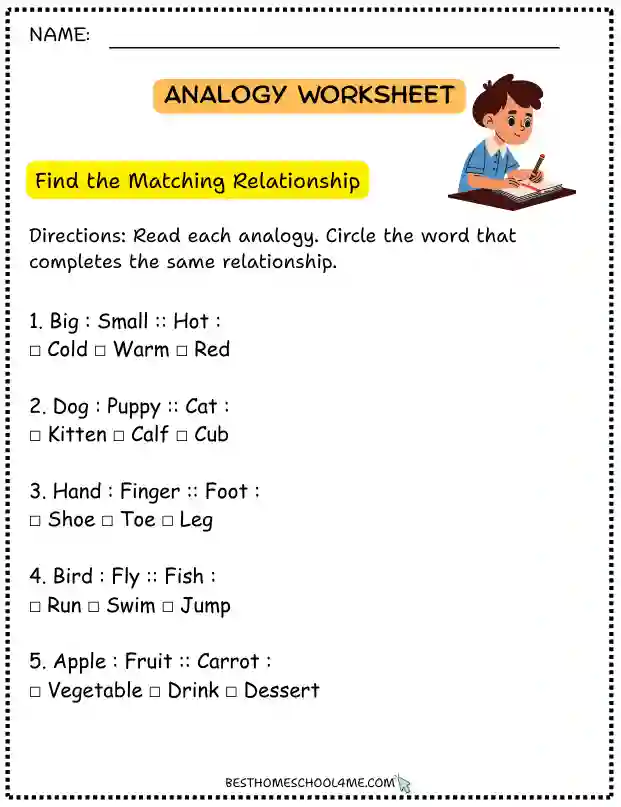
These Grade 1 analogy worksheets introduce students to simple word relationships through familiar vocabulary and everyday examples. Children practice identifying connections such as opposites, categories, part-to-whole relationships, and object functions. The three activities gradually move from guided matching to completing simple analogies, giving first graders a clear and engaging introduction to analogy practice.
Analogy Worksheets for Grade 2
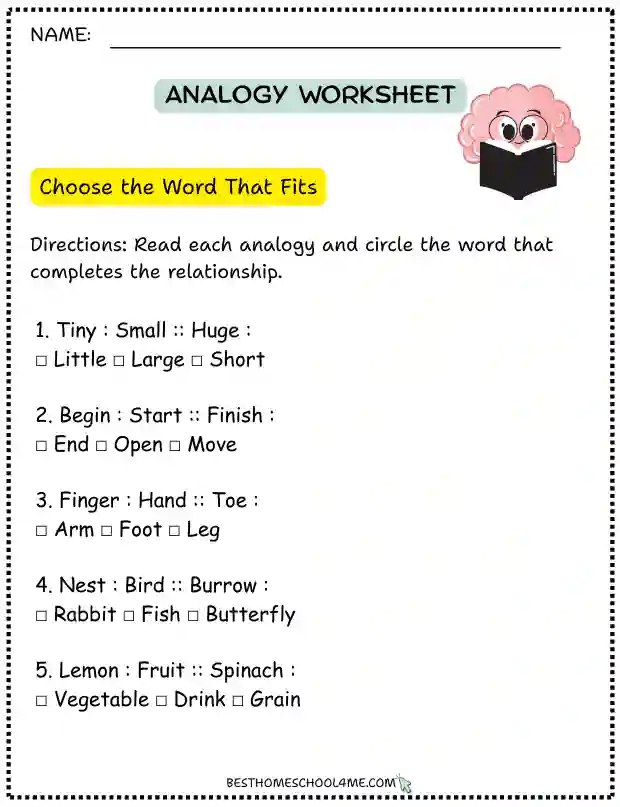
These Grade 2 analogy worksheets help students move from simple word matching to identifying and applying different types of relationships. Children practice synonyms, antonyms, part-to-whole connections, object functions, categories, and everyday associations. The three worksheets gradually increase in difficulty, giving second graders structured analogy practice while strengthening vocabulary and logical thinking.
Analogy Worksheets for Grade 3
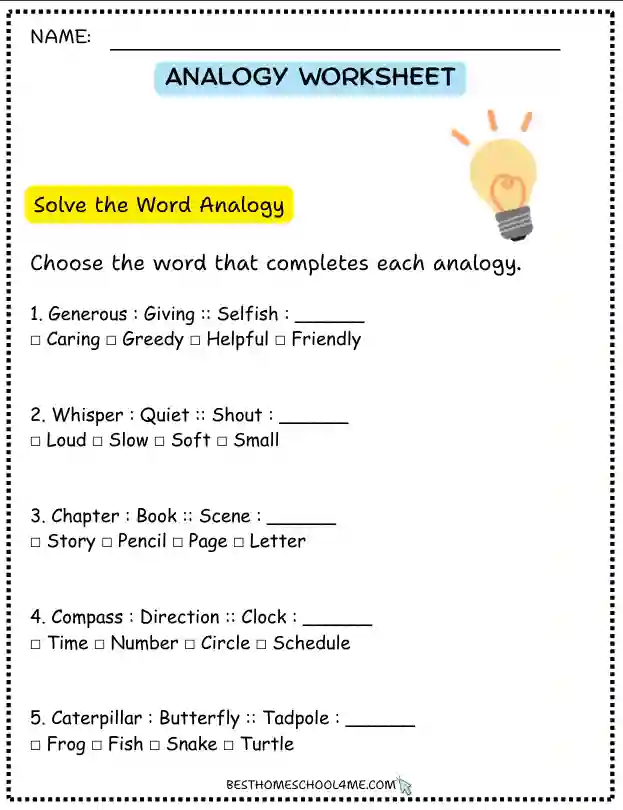
These Grade 3 analogy worksheets give students focused practice with vocabulary, comparison, and logical reasoning. The activities include synonym and antonym relationships, part-to-whole connections, object and function pairs, categories, locations, and cause-and-effect relationships. Students move from selecting answers to explaining the relationship, helping them develop a deeper understanding of how words and ideas connect.
Analogy Worksheets for Grade 4
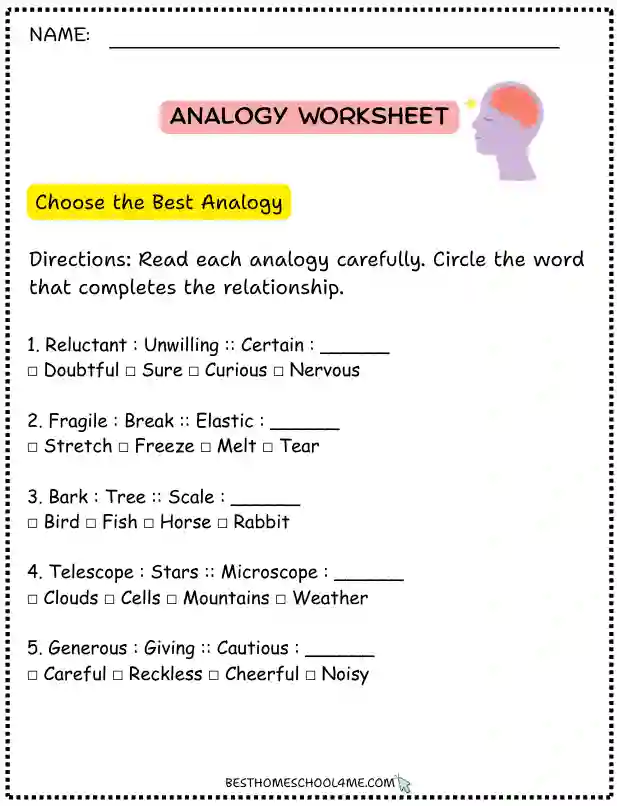
These Grade 4 analogy worksheets challenge students to look closely at how words are connected and apply that relationship to a new pair. The activities include synonyms, antonyms, part-to-whole relationships, tools and their purposes, categories, cause and effect, and word associations. Students also practice explaining their reasoning, making these analogy exercises useful for vocabulary development, reading skills, and logical thinking.
Analogy Worksheets for Grade 5
These Grade 5 analogy worksheets provide more advanced practice with vocabulary, logical reasoning, and complex word relationships. Students work with academic and descriptive words while identifying relationships involving synonyms, antonyms, cause and effect, part to whole, function, degree, and category. The activities encourage students to explain how each pair is connected rather than relying on simple word matching.
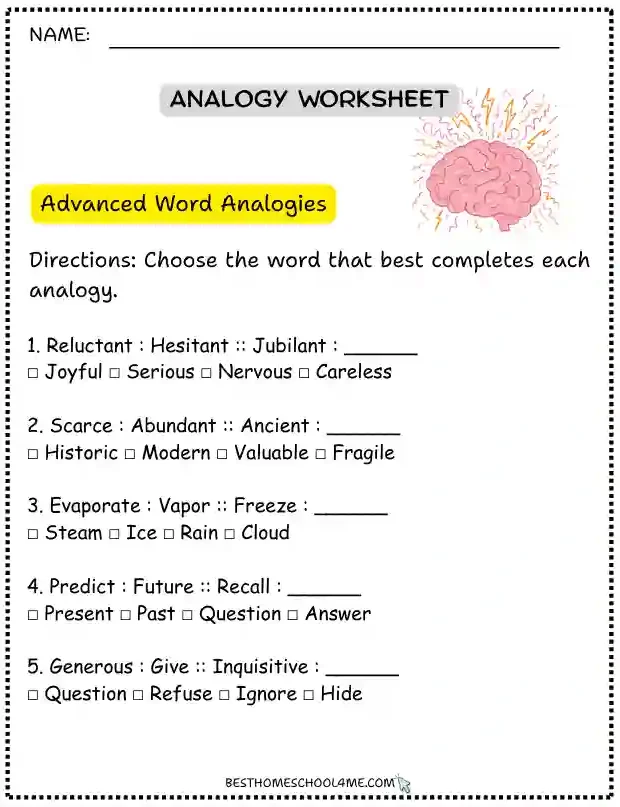
If you want the full bundle of analogy worksheets, covering Pre-K through Grade 5, simply scroll down to the bottom of the page.
How to Use Analogy Worksheets in the Classroom?
- Morning work
- Bell ringers
- Vocabulary practice
- Literacy centers
- Independent practice
- Homework
- Small-group instruction
- Intervention
- Review activities
- Substitute teacher plans
How to Use Analogy Worksheets at Home
- Start with familiar vocabulary
- Read both word pairs aloud
- Ask children to explain the relationship
- Encourage complete-sentence reasoning
- Move from multiple choice to independent completion
- Review incorrect answers together
Explore More Worksheets-
- Practice cursive writing step by step with free printable worksheets
- Free Printable Double Entendre Worksheets
- Cursive writing practice sheets from full paragraphs
- Uppercase and Lowercase Cursive Alphabets Writing Worksheets
- All Lowercase Cursive Letters a To z Writing Worksheets
- All Uppercase Cursive Letters A To Z Writing Worksheets
- Download ALL *LATEST* Practice Sheets For Kids
- Master Cursive Writing with These Fun Worksheets!
- *ALL New* Cursive Writing Paragraph sheets For kids for Kids Learning Writing
- Explore Printable Personal Goal Development Worksheets
- Download Free Fruit of the Spirit: Faithfulness Worksheets and make learning God’s Word fun for kids!
- Native American cultural coloring printables for elementary students
Frequently Asked Questions About Analogy Worksheets
1. What are analogy worksheets for kids?
Analogy worksheets for kids are practice activities that help students identify relationships between words, objects, or ideas. Children learn to compare connections such as synonyms, antonyms, part-to-whole, object-to-function, and cause-and-effect relationships while building vocabulary and reasoning skills.
2. What do students learn from analogy practice worksheets?
Analogy practice worksheets help elementary students strengthen vocabulary, logical thinking, reading skills, and their ability to recognize word relationships. By identifying how one pair is connected and applying the same pattern to another pair, students practice reasoning instead of simply memorizing word meanings.
3. What grade levels are analogy worksheets appropriate for?
Analogy worksheets can be adapted for several elementary grade levels. Simple picture and word relationships work well for Pre-K through Grade 2, while Grade 3, Grade 4, and Grade 5 students can practice more challenging vocabulary and abstract relationships. The difficulty should match each student’s reading and reasoning level.
4. How do you solve analogy questions for elementary students?
To solve an analogy question, first examine the first pair of words and determine their relationship. Next, describe that connection in a simple sentence. Finally, apply the same relationship to the second pair and choose the word that completes the pattern. Regular analogy practice helps students solve word relationship questions more confidently.