
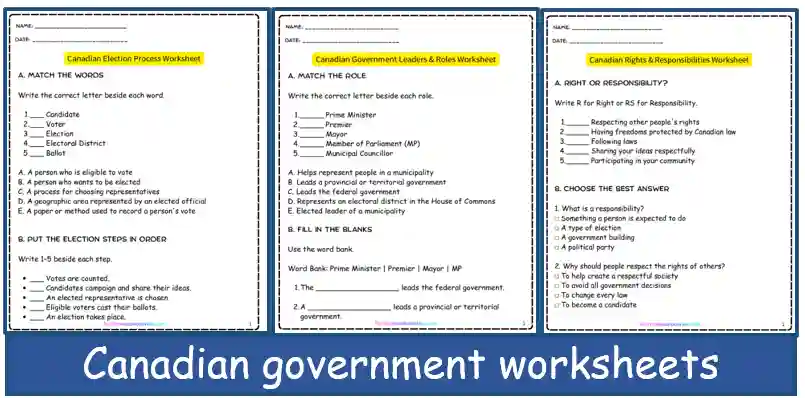
Canadian Government Worksheets for Grade 5 provide an engaging way for students to learn how government and democracy work in Canada. These printable activities introduce important topics such as the federal, provincial and municipal levels of government, elections, political representation, citizenship, rights and responsibilities, and Canadian government vocabulary. Instead of learning these concepts only through textbooks, students can practise what they know with reading passages, matching activities, multiple-choice questions, fill-in-the-blanks, and real-life government scenarios. Canadian Government Worksheets for Grade 5 can be used by classroom teachers, parents, homeschoolers, and tutors for Social Studies lessons, independent practice, homework, or review. These activities focus on Canadian civics and government topics and can complement Social Studies learning expectations across different provinces and territories.
What Will Students Learn From Canadian Government Worksheets?
Canadian Government Worksheets for Grade 5 help students build a clear, age-appropriate understanding of how government works and how people participate in Canadian democracy. Through a variety of activities, students can learn important government vocabulary, explore the responsibilities of different levels of government, and connect civics concepts to everyday life. These worksheets also give students opportunities to practise reading, comprehension, critical thinking, and communication skills while learning about Canada.
What Is the Canadian Government?
The Canadian government is the system people use to make decisions, create laws, provide public services, and help communities function. Government affects many parts of everyday life, from schools and roads to public safety and community services. Canada has different levels of government, and each level has its own responsibilities. Learning about government helps Grade 5 students understand how decisions are made and how those decisions can affect people in their communities.
Government in Canada
A government helps organize society by making decisions and creating rules that support the needs of the people. Different levels of government are responsible for different areas, so responsibilities can be shared across the country, provinces and territories, and local communities.
- What does a government do? Governments make and apply laws, manage public programs, collect taxes, and make decisions about services and resources. Their responsibilities vary depending on the level of government.
- Why do communities need governments? Communities have many needs that are difficult for individuals to manage on their own. Governments help organize services, establish rules, manage public resources, and address issues that affect groups of people.
- How do governments make decisions? Governments make decisions through established processes. Elected representatives discuss issues, consider information and different perspectives, and take part in debates, votes, and other decision-making processes.
- How do governments provide services? Governments use public funds and organize programs and services that support communities. Depending on the level of government, these may include education, health services, transportation, roads, parks, public safety, and other community needs.
- How do citizens participate? People can participate in Canadian civic life in several ways. Eligible citizens can vote in elections, learn about public issues, communicate with elected representatives, take part in community activities, and contribute their ideas to discussions about their communities.
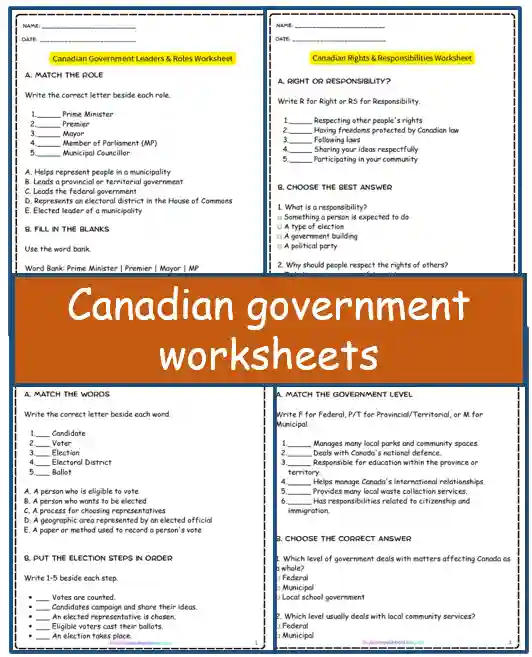
Three Levels of Government in Canada
Canada has three main levels of government: federal, provincial or territorial, and municipal. Each level has different responsibilities and makes decisions about different parts of life in Canada. Learning the difference between these levels helps Grade 5 students understand who is responsible for particular laws, programs, and services. A simple way to remember them is to think about Canada, the province or territory, and the local community.
Federal Government
The federal government makes decisions that affect the country as a whole. It deals with matters that are national in scope and works on issues involving Canada as a country. Federal responsibilities include areas such as national defence, citizenship and immigration, currency, criminal law, and international affairs.
Some important federal responsibilities include:
- National defence: Helps protect Canada and supports the country’s defence and security.
- Citizenship and immigration: Establishes rules and programs related to becoming a Canadian citizen and immigrating to Canada.
- Currency: Oversees Canada’s monetary system and the Canadian dollar.
- Criminal law: Creates criminal laws that apply across Canada.
- International affairs: Represents Canada in its relationships and activities with other countries.
Provincial and Territorial Governments
Provincial and territorial governments are responsible for matters within their own province or territory. Their responsibilities can differ depending on the specific province or territory, but many include services that people use regularly. Education, health care, transportation, and natural resources are examples of areas commonly connected with provincial or territorial government.
Some responsibilities include:
- Education: Oversees the public education system and establishes education policies within the province or territory.
- Health care: Plays a major role in organizing and delivering publicly funded health services.Transportation: Manages provincial or territorial transportation systems, including many highways and transportation rules.
- Natural resources: Helps manage resources such as forests, minerals, fisheries, and energy within provincial or territorial jurisdiction.
- Other provincial or territorial responsibilities: May include areas such as property and civil rights, provincial or territorial courts, and other services established under the Constitution.
Municipal Government
Municipal governments make decisions about local communities such as cities, towns, villages, and other municipalities. They focus on services and issues that directly affect people where they live. Municipal responsibilities can vary from one community to another.
Common municipal responsibilities include:
- Local roads: Maintains many local streets and helps manage local transportation infrastructure.
- Parks: Develops and maintains public parks, playgrounds, and recreational spaces.
- Libraries: Supports public library services and local library facilities.
- Waste collection: Organizes services such as garbage, recycling, and other waste management programs.
- Local planning: Makes decisions about land use, development, zoning, and how communities grow.
- Community services: Provides or supports local programs and facilities that serve residents.
Important Canadian Government Leaders and Roles
Canada’s government includes different leaders and elected representatives, each with specific responsibilities. Learning these roles helps Grade 5 students understand who makes decisions and represents people at the federal, provincial or territorial, and municipal levels.
Prime Minister
The Prime Minister leads the federal government and works with Cabinet to make decisions about matters that affect Canada as a whole.
Premier
A Premier leads a provincial or territorial government and helps make decisions about issues within that province or territory.
Mayor
A Mayor is the elected leader of a municipality. Mayors work with municipal councils on local services and community matters.
Member of Parliament
A Member of Parliament (MP) is elected to represent an electoral district in the House of Commons. MPs take part in discussions and votes on federal matters.
How Do Elections Work in Canada?
Elections are an important part of Canada’s democratic system. During an election, eligible voters choose candidates to represent their communities. Learning the basic steps helps Grade 5 students understand how people participate in choosing representatives.
What Is an Election?
An election is a process in which eligible voters cast ballots to choose representatives.
Who Can Vote?
Canadian citizens who meet the legal requirements, including the required age, can vote in federal elections. Different elections can have their own rules.
What Is a Political Party?
A political party is an organized group of people who share ideas about how government should work and put forward candidates during elections.
What Is a Candidate?
A candidate is a person who seeks to be elected as a representative.
What Is a Riding or Electoral District?
An electoral district, sometimes called a riding, is a geographic area represented by an elected official.
Why Do People Vote?
Voting gives eligible citizens an opportunity to participate in choosing representatives and take part in Canada’s democratic process.
How Are Representatives Chosen?
Eligible voters cast their ballots for candidates in their electoral district. After the votes are counted, the candidate who receives the most votes in that district is elected.
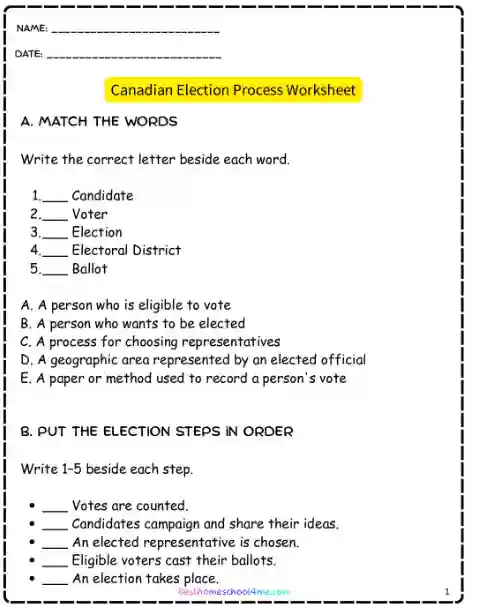
Canadian Election Process Worksheet
This Grade 5 worksheet introduces students to the basic steps of an election in Canada. Students practise key terms such as candidate, voter, ballot, election, and electoral district while learning how eligible voters choose representatives. The activities are designed to make the election process simple, clear, and easy to review during a Canadian Social Studies lesson.
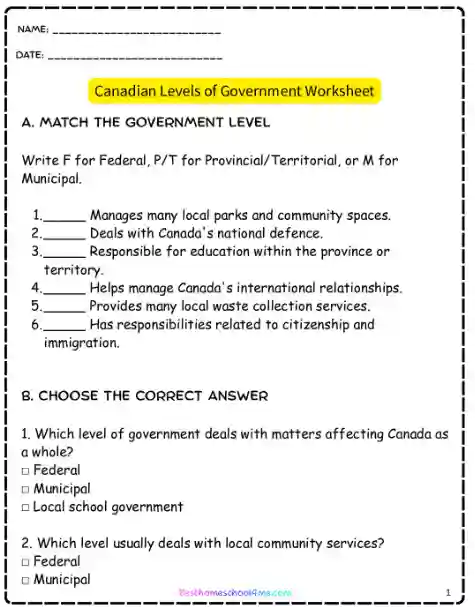
Levels of Government Worksheet
Students identify the three levels of government in Canada and connect each level with common responsibilities. This worksheet helps Grade 5 students understand the difference between federal, provincial or territorial, and municipal government.
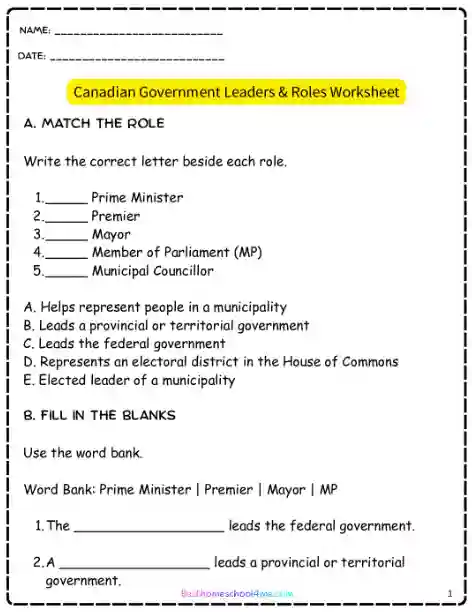
Canadian Government Leaders Worksheet
This activity introduces students to important government roles without overwhelming them with complicated political terminology. Students match leaders and representatives with their basic responsibilities.
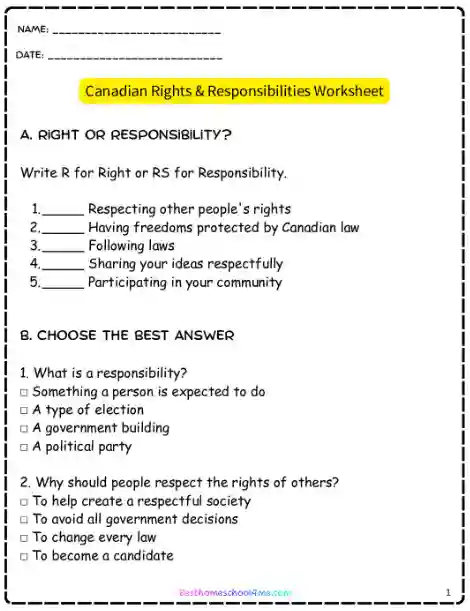
Canadian Government Rights & Responsibilities Worksheet
Students explore the difference between rights and responsibilities using simple, everyday examples. The worksheet encourages students to think about how people can participate respectfully in Canadian society.
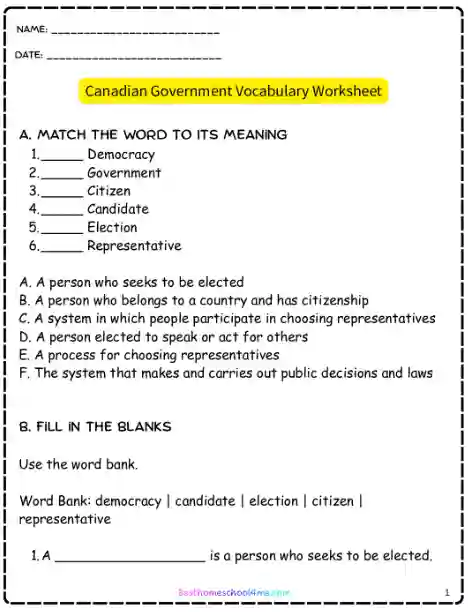
Canadian Government Vocabulary Worksheet
This Grade 5 Canada civics worksheet introduces students to the basic steps of an election in Canada. Students practise key terms such as candidate, voter, ballot, election, and electoral district while learning how eligible voters choose representatives. The activities are designed to make the election process simple, clear, and easy to review during a Canadian Social Studies lesson.
Explore More Worksheets-
- Practice cursive writing step by step with free printable worksheets
- Free Printable Double Entendre Worksheets
- Descriptive and Limiting Adjectives Worksheets
- Download ALL *LATEST* Practice Sheets For Kids
- Analogy Worksheets
- *ALL New* Cursive Writing Paragraph sheets For kids for Kids Learning Writing
- Explore Printable Personal Goal Development Worksheets
Can I use Canadian government worksheets for Grade 5 at home or in the classroom?
Yes. These worksheets can be used by teachers, parents, homeschoolers, and tutors for Social Studies lessons, homework, independent practice, or review. You can choose individual activities based on the topic students are currently learning, such as Canadian elections, levels of government, government roles, or rights and responsibilities.
How can Canadian government worksheets help Grade 5 students?
Canadian Government Worksheets for Grade 5 turn complex civics topics into manageable activities such as matching, vocabulary practice, reading comprehension, sequencing, and short-answer questions. They can help students review key terms, understand government responsibilities, and apply what they learn to simple real-life situations.
What do Grade 5 students learn about the Canadian government?
Grade 5 students can learn how Canada’s government is organized, including the three levels of government, government responsibilities, elections, elected representatives, democracy, and civic participation. Canadian government worksheets make these concepts easier to practise through age-appropriate questions and activities.